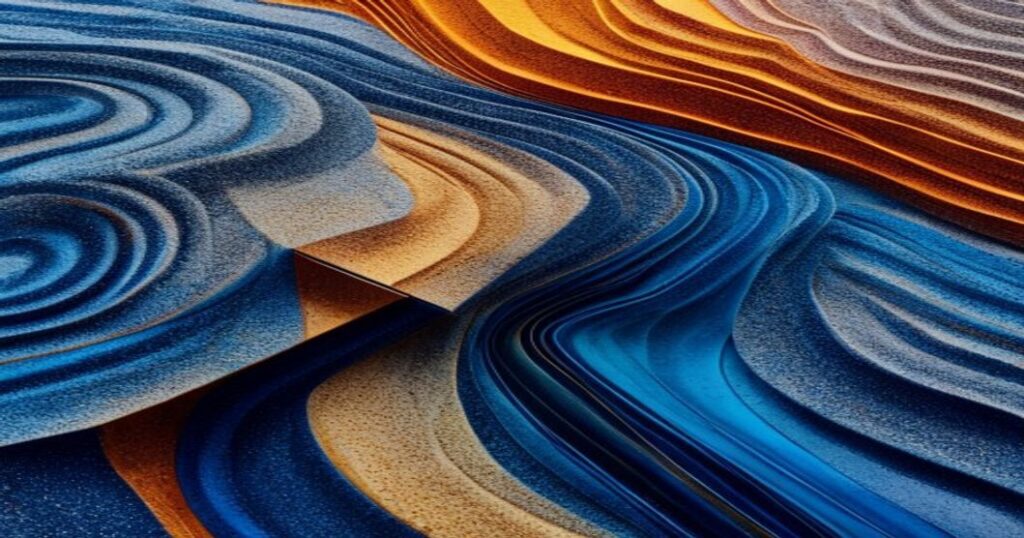
Pick up a moving sand picture. Flip it. Watch the sand begin to fall, settle, layer, form a landscape. Wait a few minutes. Flip it again. A different landscape forms.
Do it a third time. A fourth. A hundredth. Each time, a different landscape. The pattern never repeats.
After enough flips, an obvious question forms: will it ever repeat? If you flipped the same moving sand picture every minute for the rest of your life — and your children continued, and their children — would the same pattern ever recur? Or are the patterns produced by a moving sand picture, in some meaningful sense, infinite?
This question turns out to be deeper than it sounds. It connects to mathematics, to the physics of granular flow, to information theory, and to some genuinely beautiful philosophical questions about what counts as “the same” pattern.
This is a small essay on those questions, from the perspective of someone who builds sand pictures and has thought about this more than is probably reasonable.
The Naive Answer
Let’s start with the naive case. A moving sand picture contains a finite number of grains of sand — let’s say, for the sake of argument, ten million grains. Each grain has a position in the cavity (constrained by the cavity geometry) and a color.
The total number of possible configurations of these grains is large but finite. Even if each grain could occupy a thousand distinguishable positions, the total number of arrangements is a number with many millions of digits — but it is finite.
So in the strict combinatorial sense, the patterns produced by a moving sand picture are not infinite. They are merely very, very large in number.
But this answer misses what’s actually interesting. The combinatorial bound includes configurations that the picture cannot actually produce — like all sand grains on one side, or all sand grains in a perfect cube. The picture can only produce arrangements that arise from the physics of the flow, which is a much smaller subset.
The interesting question isn’t how many configurations are mathematically possible. It’s how many configurations does the actual flow produce, and how often do they repeat in practice?
The Physics of Granular Flow
To get at the deeper answer, we have to look at how granular flow actually works.
Granular materials — sand, gravel, powders — have a strange property: they behave neither quite like solids nor quite like liquids. A pile of sand can hold a shape (like a solid). But pour the sand and it flows (like a liquid). The transitions between these behaviors are governed by complex physics involving friction between grains, the weight of the grain pile, the geometry of the container, and the dynamics of any fluid the grains are immersed in.
For a moving sand picture specifically, the relevant physics involves:
- The viscous drag of the glycerin-water liquid on each grain
- The gravitational settling of grains by density and size
- The interaction between grains as they touch each other in flow
- The migration of the air bubble through the cavity, which pushes sand around
- The boundary effects at the cavity walls and at the front and back glass
These are all deterministic in a strict sense — the physics is fully described by laws of motion, fluid dynamics, and granular mechanics. In principle, given perfect knowledge of the initial conditions, you could predict every grain’s path through the flow.
In practice, this is hopeless. The system is chaotic in the technical sense — tiny variations in initial conditions produce wildly different outcomes. A grain that starts a millimeter to the left of where another grain started can end up in a totally different position after the flow. The system is deterministic but practically unpredictable.
This is the regime that produces variety. The flow is so sensitive to small variations that no two flips ever start from precisely the same state, and so no two flows produce precisely the same outcome.
The Sources of Variation
What are the variations that prevent repetition? Several.
The starting configuration. Each flip starts from a slightly different settled state than the previous one. The sand has settled in a particular landscape; flipping inverts that landscape; the new flow begins from this inverted state, which is different every time.
The flip itself. Tiny variations in the speed, angle, and timing of the human flip introduce variation. The sand-air system is sensitive enough that even small variations in flip dynamics propagate.
Temperature. Glycerin viscosity varies slightly with temperature. The flow at 18°C behaves slightly differently than the flow at 22°C. Every flow occurs at a slightly different ambient temperature.
Air pocket dynamics. The migration of the air pocket through the sand is genuinely chaotic. The pocket can split, merge, deform, and reform in ways that are different every time.
Sand grain interactions. Even between identical sand grains, the contacts and forces between them in any specific flow depend on micro-arrangements that change with each flow.
The cumulative effect of these variations is enormous. Each flow’s initial conditions differ from every previous flow’s initial conditions by amounts that, while small, are large enough to produce completely different macroscopic outcomes.
The Pigeonhole Argument
Here’s where the philosophy gets interesting.
In the strict combinatorial sense, the picture has a finite (though astronomically large) number of possible configurations. So if you flip the picture an infinite number of times, by the pigeonhole principle, some configuration must repeat. Repetition is mathematically guaranteed in the limit.
But: how long would it take for repetition to actually happen?
If we estimate that a moving sand picture can produce, say, 10^20 distinguishably different settled landscapes (a very rough estimate; the actual number is probably much larger), and you flip it once a minute for the rest of your life — say, 50 million flips over a long lifetime — you have made an extraordinarily small dent in the total space of possible patterns. The probability of repeating any specific pattern within those 50 million flips is essentially zero.
In practical, lived-experience terms: no human will ever see the same flow twice from a moving sand picture. The patterns are infinite in the operational sense even if not in the strict mathematical sense.
The Deeper Question: What Counts as “the Same” Pattern?
Even the pigeonhole argument depends on how you define “the same pattern.” This is where the philosophy gets really interesting.
Consider two flows of a moving sand picture. The settled landscapes look superficially similar — both have an amber layer at the bottom, blue in the middle, a white cap at top, with a few peaks and valleys. To the casual eye, they’re “the same” landscape.
Look more carefully and you see they’re not identical. The peaks are in different positions. The white cap has different curves. The amber layer has different undulations. They’re variations on a theme, but they’re different.
Look even more carefully — at the position of every individual grain — and they’re radically different. Every grain in flow A is in a different position than every corresponding grain in flow B.
So what counts as “the same” pattern?
If we count “same” at the grain-level resolution, the patterns are essentially infinite — no two flows are ever the same.
If we count “same” at the macroscopic-landscape resolution, the patterns are still vast — many thousands of distinguishable landscape types, each with many subtypes.
If we count “same” at the most coarse level — “an amber-blue-white layered landscape” — the patterns are not infinite at all. There might be only a few dozen high-level pattern types that emerge.
The interesting truth is that at every level of resolution, there’s variation. The patterns are infinite at fine resolution and finite at coarse resolution. Where you call the patterns “infinite” depends on how closely you’re looking.
This is, I think, true of a lot of natural phenomena. Are clouds infinite in their variety? Are snowflakes? Are tree shapes? At the molecular level, every cloud is unique. At the level of “cumulus or cirrus or stratus,” there are only a few categories. The infinitude lives in the details; the categories are bounded.
A moving sand picture participates in the same paradox.
The Aesthetic Experience of Non-Repetition
Whatever the mathematical answer, the aesthetic experience of non-repetition is real.
When you flip a moving sand picture and watch a new pattern form, you have a strong subjective sense that you are watching something that has never existed before and will never exist again. The grains are arranging themselves into a configuration that, by the physics of the system, is unique to this moment.
This sense — of witnessing something genuinely unique — is one of the things that makes moving sand pictures particularly engaging. Most decor is the same every time you look at it. A moving sand picture is different every time. The freshness is built into the medium.
The same is true of natural slow-motion phenomena. A sunset is different every evening. Clouds are different every day. The pattern of frost on a window is different every cold morning. Watching these things, you have the same subjective sense of witnessing something unique.
There’s something deep going on with this kind of experience. We’re not built to find absolute repetition very interesting; we’re built to attend to variation. Slow-motion phenomena that produce continuous variation tap into this deep attentional bias and give us a kind of aesthetic engagement that purely static decor doesn’t.
The Practical Implication
If you own a moving sand picture, here’s what this means in lived terms:
You can keep flipping it for your entire life and never see a repeat pattern that you’d register as identical to a previous one. The variety is, for human-experience purposes, inexhaustible.
This is one of the things that distinguishes a moving sand picture from a static decoration. A painting on the wall produces the same image every time you look at it. After a while, your visual system stops paying attention; the painting becomes background. A moving sand picture, by contrast, produces a different image every time you flip it. There’s no visual habituation in the same way. The piece stays fresh in a way static decor cannot.
This is the underrated practical value of moving art objects. They earn their place not just by their initial impact but by their continuing variety.
A Final Thought
In a world where almost everything we own is produced by mass manufacturing — designed once, replicated identically thousands or millions of times — a moving sand picture is one of the few household objects that produces genuinely unique outputs. Each landscape is one-of-a-kind. None can be archived, photographed-and-recreated, or repeated.
The closest analogues are the natural phenomena: clouds, sunsets, snowflakes. Things that, every time, are once-only.
To have a small object in your home that participates in this kind of inexhaustible variety — that is, in its small way, infinite — is a quiet and unusual luxury. Most things in your house are finite in what they show you. A few things, including the slow-flowing sand picture, are not.
That’s worth noticing.
Vee Sharma is a designer and the founder of Moving Sandscape. The studio produces a small range of handcrafted kinetic sand pictures, including the deep-sea sandscape, and Vee writes the editorial essays here. About Vee →