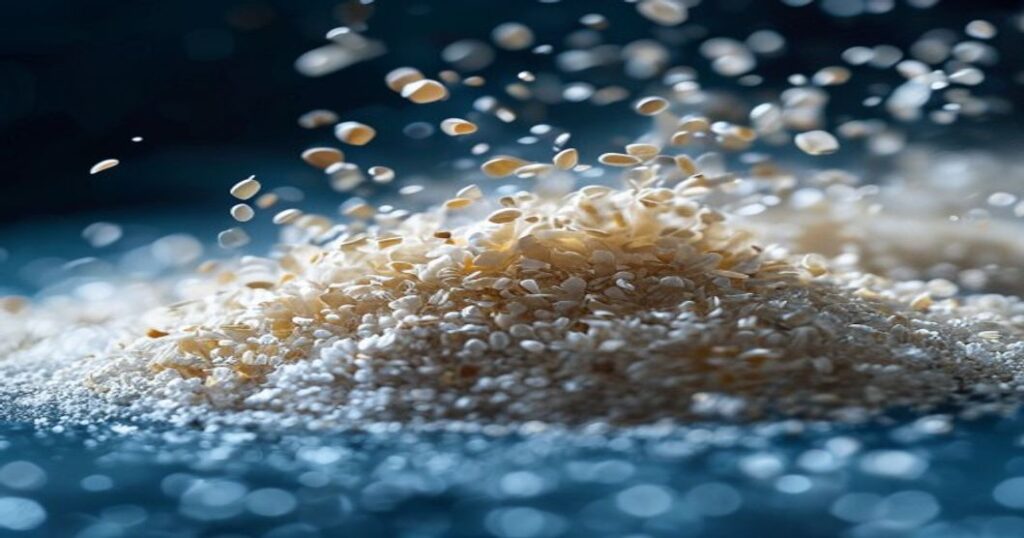
Ask a physicist what sand is, and you’ll get a longer answer than you expected.
It’s clearly not a solid — it pours, it flows, it shifts shape the instant you tilt the container. But it isn’t a liquid either — lay a book on top of it and the book just sits there, supported, as if by a floor. Scoop a handful and it behaves like powder for a moment, then holds the shape of your palm, then collapses when you open your fingers. Sand is, in some specific scientific sense, none of the standard states of matter — and the equations that describe it are still being written.
Granular flow — the technical name for how sand, rice, sugar, snow, ball bearings, pharmaceutical pills, industrial grains, and coffee beans all move — is one of the most unsolved problems in classical physics. It sounds impossible. We’ve mapped the inside of atoms. We’ve described the gravitational waves of colliding black holes. But we cannot, in 2026, predict with full accuracy how a dune will reshape itself overnight, or exactly when an avalanche will release on a tipped hillside of sand, or why an hourglass flows at the rate it does.
This is the story of why, and what it means — from silo collapses to Nobel-adjacent physics to the miniature granular drama that plays out every time you flip a moving sand picture on a shelf.
The Dual Nature of Sand
Let’s start with the weird thing that kicks off the whole field.
Pour sand into a bucket. It flows. Water-like. Takes the shape of the container, levels out at the top, behaves — for a few seconds — like a slightly chunky liquid.
Then it stops. The pile holds a shape. There’s a steep angle at the edge, formed as you poured, that stays there. This is the angle of repose — the steepest slope a loose granular material can hold without collapsing. For dry sand, it’s around 30–35 degrees. For snow, it’s 38 degrees. For rice, around 34. The angle holds because the particles lock against each other through friction and gravity in a way that resists the next tiny push.
Now tilt the bucket. The pile holds. Tilt further. Still holds. Further. Then — suddenly, not gradually — the surface goes, and an avalanche ripples down the slope.
That word suddenly is the whole problem.
The Problem With “Suddenly”
When water overflows, it overflows continuously. There’s no drama. Each molecule of water experiences forces proportional to the forces on it, and when the tilt passes the threshold, flow begins, smoothly.
Sand doesn’t do that. Sand sits, sits, sits, then collapses. The transition from “solid pile” to “flowing avalanche” is not a gradual ramp but a sharp, almost binary event. Physicists call this transition between stable granular solid and flowing granular liquid the jamming transition, and it’s one of the hardest problems in the field.
Why is it hard? Because the forces inside a granular pile are not shared evenly. Imagine a sack of marbles. You might assume that if the sack is gently squeezed, every marble feels equal pressure. It doesn’t work that way. The force runs in force chains — zigzagging networks of a few heavily loaded grains that happen to be touching in the right geometry to carry most of the weight. Most grains in the pile carry almost nothing. A few carry enormous load.
When you tilt the pile, or add a grain, or shake it, you don’t smoothly increase force across the whole system — you stress the force chains. A chain holds, holds, holds — and then one link slips. The load re-routes. Usually another chain forms and absorbs it. But sometimes, the re-routing triggers another slip, which triggers another. This is an avalanche.
And there is no way, given current physics, to predict which grain’s slip will cascade and which won’t. The internal geometry of a specific pile of sand is too complex, too contingent on microscopic detail, for our current equations to solve.
Where This Shows Up
“Interesting physics puzzle” you might say. It’s more than that. Granular flow failures cause real, consequential events.
Grain silo collapses. Industrial silos holding corn, wheat, or soy occasionally implode when the flow of grain during unloading becomes unstable. Engineers have to design silos with an enormous safety margin because the precise conditions that trigger a collapse are still being mapped.
Landslides. A landslide is, essentially, a massive granular flow event, often triggered when rain reduces the friction between grains of soil. Predicting exactly when a saturated hillside will give is still an open problem, which is why most landslide prediction relies on monitoring movement in real time rather than modeling from first principles.
Snow avalanches. Same physics, different material. Avalanche forecasters can describe general conditions that are risky (recent snowfall, warming, specific slope angles) but cannot predict individual release events, because the internal force-chain structure of a snowpack is too complex to fully characterize.
Pharmaceutical tablets. Pill manufacturers have to solve granular flow problems at industrial scale — if powder doesn’t flow consistently through the machine, each pill gets a different dose. Minor variations in grain shape or humidity can change everything.
Moving sand pictures. The thing sitting on your shelf, if you own one. Every flip of a moving sand frame is a contained demonstration of the same physics that makes landslides hard to predict.
What Happens Inside a Moving Sand Frame
A moving sand picture is, in engineering terms, a transparent container holding two or more colors of sand, suspended in a liquid (usually glycerin and water with a small trapped air bubble), pressed between two thin plates of glass. When you flip it upside down, gravity starts pulling the heavier grains through the lighter liquid. The trapped air bubble rises. Sand falls. The colored grains, moving at different speeds because of their different densities and shapes, begin forming patterns as they settle.
What you’re watching, specifically, is granular flow happening slowly enough to see.
In a fast-moving sand pile — say, when you dump a bucket — the avalanches happen in a few seconds. Too fast for your eye to register the individual events. But in a moving sand frame, because the sand is falling through liquid rather than through air, the flow is slowed by orders of magnitude. A grain that would fall to the ground in half a second in open air takes many seconds to cross the frame. What your eye sees is the slow-motion version of the same physics that controls an avalanche.
And you see — clearly, undeniably — the sharp transitions that puzzle physicists. Sand accumulates at the air bubble as it rises. The pile steepens, steepens, steepens, and then slides in a sudden avalanche. The cascade pauses. Accumulates again. Slides again. What physicists call intermittent granular flow is playing out on a coffee table at human-visible speed.
This is a large part of why these pictures feel hypnotic. Your brain is watching a physical process that it rarely gets to see — one normally too fast, too violent, or too buried to observe. The slow-motion avalanche is inherently fascinating to the attention system.
Self-Organization: Where Mountains Come From
Here’s the other strange thing about granular flow.
When sand falls through a moving sand picture, it doesn’t settle into random bumps. It forms mountains. Ridges. Layered bands where one color sits on top of another. The formations look intentional — landscape-like, architectural. No one designed them. They emerge.
This is a phenomenon called self-organization or self-organized criticality, first formally described by physicist Per Bak in the 1980s using the sandpile as his main model. Bak’s argument was that a pile of sand, continuously fed new grains from the top, naturally evolves toward a critical state — an angle of repose — where any new grain can trigger an avalanche of any size, from a single grain sliding to a massive cascade. The avalanche-size distribution follows a power law: most avalanches are tiny, a few are medium, very few are enormous, and the pattern recurs at every scale.
This is the same mathematical signature that shows up in earthquakes, forest fires, stock market crashes, neural avalanches in the brain, and the extinction events in the fossil record. All of them, Bak argued, are systems poised at critical states, where the same internal logic — store stress, dissipate it in avalanches, resume storing — plays out at many scales.
A moving sand picture is, in this framing, a small self-organized critical system running in your living room. The mountains that form in it are not random — they are the natural equilibrium shapes that emerge from the continuous push-and-release of granular mechanics. Which is why they look like real landscapes: because the forces shaping them are the forces that shape real landscapes.
Why This Matters for How We Watch
There’s a reason that watching granular flow — in a moving sand picture, in an hourglass, in a timelapse of a dune — is such a particular kind of soothing.
It’s not just “slow things are calming.” A candle is slow but doesn’t produce the same effect. A metronome is regular but doesn’t either. Sand is different because it is slow and unpredictable and self-organizing. Your visual attention system can’t predict the next avalanche, but it can track each one as it happens. It’s a continuous, low-stakes puzzle that keeps the attention system softly engaged without ever taxing it.
Psychologists Rachel and Stephen Kaplan, in their work on attention restoration theory, argued that certain stimuli — clouds moving, leaves rustling, water flowing — occupy the attention system in a way that rests it rather than depleting it. They called this soft fascination. Granular flow falls cleanly into this category. It’s the reason that ancient meditation practices often involve watching water, sand, or fire: slow, naturally self-organizing systems are specifically restorative to human attention in a way that engineered, predictable objects are not.
Which circles back to why a moving sand picture works as a household object in a way that a screen saver doesn’t. The screen saver cycles through predictable patterns and loses your attention fast. The sand picture is forever novel — every flip, every avalanche, every settling pattern is genuinely unique, because the underlying physics is computationally unpredictable.
Questions People Actually Ask About Sand Physics
Is sand technically a liquid, a solid, or something else?
Physicists classify granular materials as a fourth state of matter in some frameworks — distinct from gas, liquid, and solid. They share properties with all three but fit none cleanly.
Why can’t we predict avalanches from the equations of physics?
We have equations that describe individual grain collisions well. But the number of grains in any real pile is so large, and the force-chain structure so sensitive to microscopic geometry, that aggregating those equations into a full prediction is computationally intractable. It’s a “we know the physics but can’t compute the answer” problem.
Does temperature affect granular flow?
Surprisingly little, for small changes. Granular materials don’t have thermal motion at the grain scale the way molecules do — they’re too heavy. Physicists sometimes talk about a “granular temperature” (average kinetic energy of grains from external vibration), which is a different concept entirely.
Is the sand in a moving sand picture special?
It’s sorted for grain size and density, and there are usually two or more colors with slightly different properties so they separate into layers as they fall. Otherwise, it’s real quartz and silica sand, dyed.
Why does the same picture never make the same pattern twice?
Because the internal initial conditions — exactly where each grain is in the liquid, where the air bubble first forms, which grain starts the first avalanche — change every flip. And because the system is sensitive to those conditions (small input differences cause large outcome differences), the result is effectively infinite variation.
Is there a mathematical limit to how many patterns a sand picture can form?
In theory, the state space is bounded (a finite number of grains in a finite container). In practice, the number of distinguishable patterns far exceeds the number of flips the picture could physically survive. So for all practical purposes, yes — each flip is unique.
A Note on Watching
I’ll close with the thing I keep coming back to when people ask me why I built a company around this physics.
Granular flow is one of the quiet places where modern science runs into its limits. Not the limits of imagination — the limits of prediction. The same equations that can send a probe to a specific crater on Mars cannot tell you when the sand in your hourglass will clump, or which grain will start the next mini-avalanche on your shelf.
Sitting with that, I think, is a useful thing to do sometimes. The world is not fully modeled. Small contained systems can still surprise. And those surprises aren’t chaos — they’re the signature of criticality, of systems poised between order and disorder, producing patterns that look a lot like nature because they are nature, happening slowly, in miniature, in your living room.
If that kind of slow, unpredictable, genuinely-can’t-be-modeled-by-a-screen-saver physics has any appeal to you, here’s the piece that got me into all this in the first place. It’s a deep-sea sandscape — blue, amber, white — that I’ve watched do its self-organizing thing more times than I can count. It keeps surprising me.
About the author: Vee Sharma writes the Moving Sandscape blog and designs the studio’s kinetic sand art pieces, including the deep-sea sandscape. More about Vee →