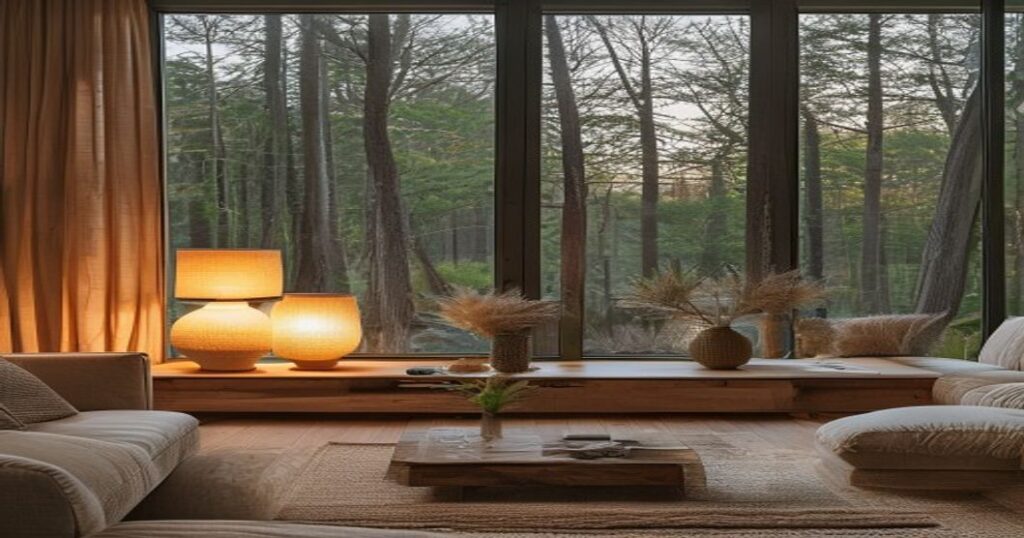
Most homes are designed to be lived in. The best homes are designed to restore you.
The distinction matters. A livable home is one where you can do your basic activities — sleep, eat, work, host friends — without the space getting in your way. A restorative home is one where the act of being in the space actively replenishes you. You come home depleted; you walk in; the space itself begins to do something. Your shoulders drop. Your breath slows. The conversation in your head quiets a little. Without you having to do anything, the home begins to put you back together.
This isn’t a metaphor. There’s a real body of research on what makes built environments restorative, and the principles are surprisingly specific. Hospitals with views of trees have better post-surgery recovery rates. Offices with natural light produce measurably less worker stress. Homes designed with certain principles have demonstrated effects on inhabitants’ mood, sleep quality, and cognitive function.
This post is an attempt to assemble what’s known about restorative design into a usable framework. Not a dogma, not a single style, but a set of principles you can apply to whatever home you have to make it more restorative.
I’ll draw on three main bodies of work: Attention Restoration Theory (Stephen and Rachel Kaplan), Biophilic Design (Stephen Kellert and others), and the slow-living and contemplative-design traditions (Christopher Alexander’s pattern language, Japanese ma, Scandinavian hygge). The principles overlap more than you’d expect.
What Restorative Design Is Trying to Do
The first move is to be specific about what we mean by “restoration.”
Restoration, in the technical sense used by environmental psychologists, refers to the recovery of cognitive resources that get depleted by directed attention — the focused, effortful kind of attention required by work, decisions, and modern urban life. Directed attention is finite; you have only so much of it per day. Restoration is the process of letting it replenish.
Restoration happens best when you’re in an environment that:
– Provides gentle, undemanding stimulation (rather than empty silence or overwhelming activity)
– Engages involuntary attention — the kind that arises naturally without effort
– Feels meaningfully different from the demanding environment you came from
– Includes a sense of being away from the pressures of regular life
– Provides coherence — the elements work together rather than competing
Natural environments do this best, which is why nature exposure is so consistently restorative in the research. But indoor environments can be designed to do much of the same work — and your home, where you spend the most hours of your life, is the highest-leverage place to apply these principles.
The Six Pillars of a Restorative Home
I’ve grouped what’s known into six principles. Each maps to specific design moves you can make.
1. Strong Connection to Nature
The most consistent finding across all the research is that nature exposure is restorative, and that even partial or mediated exposure to nature has measurable effects.
This is the core of biophilic design. Concrete moves:
Real plants — multiple, varied, throughout the home. Not just one plant in a corner; multiple plants in every room. A combination of leafy and structural; small and large; trailing and standing. The cumulative effect is what matters.
Maximum natural light. Whatever you can do to bring more daylight into your home: clear curtains during the day, reposition furniture to be near windows, mirrors to bounce light, light-colored walls. A home with abundant natural daylight feels different than the same home darkened.
Views to nature where possible. If you have any view of trees, sky, water, or garden, organize your seating to face that view. The view is part of the room’s design value.
Natural materials throughout. Wood, stone, wool, cotton, linen, leather. The cumulative effect of natural materials in furniture, textiles, and finishes makes a home feel grounded in a way synthetic materials don’t.
Water in some form. A small fountain, an aquarium, a water feature on a balcony. Even a single bowl of water on a console table.
Natural sound. Music drawn from natural sources (recordings of forests, oceans, streams) at low volume. Wind chimes near a window. The sound of a fountain.
2. Layered, Warm Lighting
Lighting is more powerful than most home designers realize. A restorative home has lighting that:
Is warm in color temperature. Warm bulbs (2700K or below) throughout. Cool light (4000K and above) is associated with alertness and stress; warm light with relaxation.
Comes from multiple sources at multiple heights. A combination of overhead, table-height, and floor lamps. The variation creates depth and softness; a single bright overhead source is harshly institutional.
Is dimmable wherever possible. The ability to lower the lighting in the evening signals the body to wind down.
Includes some firelight. A real fireplace if you have one; otherwise, candles. The slow flicker of fire is one of the most parasympathetic-activating visual experiences available.
Respects the circadian rhythm. Bright light in the morning (pull the curtains, sit by a window) and warm dim light in the evening. The home should support, rather than fight, your biological clock.
3. Thoughtful Acoustic Environment
Sound shapes how a space feels almost as much as light, and most homes pay no attention to it.
Soft surfaces that absorb sound. Rugs, fabric upholstery, throws, curtains, fabric wall hangings. Hard-surface homes (tile, glass, drywall, hardwood without rugs) are acoustically harsh and stressful even when no one is making noise.
Selective use of music or ambient sound. Not constant background, but deliberate playing of music or ambient sound at chosen moments — morning, evening, while cooking, during the wind-down.
Silence as a feature. A restorative home should also have moments of genuine silence. Turn off the TV. Close the laptop. Let the quiet exist.
Address noise pollution. Sound-blocking weatherstripping if neighbors are noisy. Heavy curtains for street noise. White noise where ambient noise can’t be eliminated.
4. Sensory Layering Without Overwhelm
A restorative home engages multiple senses gently — not all at once, not loudly.
Tactile variety. A mix of textures within reach in any room — soft, rough, smooth, woven. The hand should have things to touch.
Subtle scent. A consistent low-level scent presence — beeswax candles, fresh herbs in a vase, a single stick of incense lit briefly each morning, dried lavender in a bowl. Not perfumed; subtle.
Slow movement somewhere visible. This is the principle I’ve written about extensively — having one slowly-moving object in your visual field (a candle, a moving sand picture, a plant in a breeze, an analog clock, a small fountain) provides the soft fascination that restores attention.
Beautiful details. Small objects of craftsmanship within sightlines. A hand-thrown ceramic mug. A piece of small art. A beautifully-bound book. The eye finds beauty when it rests, and finding beauty is restorative.
5. Spatial Coherence and Pattern
Christopher Alexander’s A Pattern Language (1977) is a deeply influential book about how built environments support human flourishing. His central insight: certain spatial patterns recur in human-friendly environments across cultures because they meet real human needs.
A few of his patterns that map directly to restorative design:
Window seats and reading nooks. Small intimate spots within larger rooms where one person can be alone and contained.
Light from two sides. Rooms lit from at least two windows on different walls feel substantially better than rooms lit from a single window.
Sequence of public to private. As you move into the home, spaces should move from more social (entryway, kitchen) to more private (bedroom, bathroom). The progression itself is meaningful.
Outdoor rooms. A balcony, patio, garden corner, or rooftop accessible from the main living area extends the home and provides a transitional zone.
Eating spaces with a view. Where you eat matters. A dining table looking at a wall is sad; a dining table by a window is alive.
Things to do at the corners. Activity zones placed at room corners (a reading chair, a desk, a small altar or display) create destinations within rooms.
These patterns aren’t always achievable in existing housing, but where they can be applied, they make spaces meaningfully more restorative.
6. Removed and Simplified
Restorative design is partly about what’s there but heavily about what’s not.
Reduced clutter. Visual noise is a significant cognitive load. A space with surfaces piled with mail, half-finished projects, and miscellaneous objects is harder to be in. The cleaner the surfaces, the more restful the room.
Removed screens. TVs and visible technology in restorative rooms (especially bedrooms) work against restoration. The eye treats them as potential demands.
Removed obligations. Stacks of bills, reminders, work files. These should not be in restorative rooms. Move them to the office or hide them in drawers.
Simplified palettes. Restrained color schemes (muted, natural, warm) are more restful than highly saturated or contrasting palettes.
Empty space. Rooms with breathing room — visual emptiness around the objects that are there — feel more restful than rooms where every surface is full.
The Japanese aesthetic concept of ma — the meaningful empty space between things — is relevant here. Restorative homes have ma. Cluttered homes don’t.
Putting It Together: A Sample Restorative Home
If you wanted to redesign a room to be maximally restorative, what would it look like?
Imagine a living room. The walls are a warm off-white. There’s a wool rug on the floor. The sofa is upholstered in a textured natural-fiber fabric, with a wool throw and two textured pillows. Two natural-fiber armchairs face the sofa, forming a conversational arrangement.
There are large windows on two adjacent walls. The curtains are floor-length linen. During the day, the windows are uncovered; in the evening, the curtains are drawn loosely.
Three light sources: a warm pendant centered over the seating area (dimmer-controlled), a brass table lamp with a warm bulb, and a floor lamp by one of the chairs. All on warm bulbs. All dimmable.
A wooden coffee table — visible grain — with a single ceramic bowl on it. Beside the bowl, a single candle.
On a low console along one wall: a small kinetic art piece (a moving sand picture, a Sisyphus table, or a small kinetic sculpture). Slowly moves throughout the day.
Two living plants: one taller floor plant by the window, and a trailing plant on a high shelf.
One large piece of art on the wall (a botanical print, a landscape painting, an abstract piece in muted tones). One smaller framed personal photograph on the console.
The room is otherwise empty of objects. No visible TV. No visible workstation. No piles of mail. The surfaces are mostly clear.
This is a restorative living room. None of it is dramatic. All of it is deliberate. Spend an hour in this room versus an hour in the typical American living room (with a TV dominating one wall, multiple cluttered surfaces, harsh overhead lighting, synthetic upholstery, and no plants), and the difference in how you feel afterward is real and measurable.
The Bigger Frame
Here’s the deeper claim I’d make.
The home is not just where you live. It’s where your nervous system spends most of its waking hours. The design of the home is, therefore, an upstream determinant of your wellbeing — not in a vague way, but in the specific way that hospital architecture affects recovery rates and office design affects worker stress.
Most homes are designed by accumulation: you buy what you need over time, you arrange things as you find space, you respond to what’s available rather than designing intentionally. This is fine. But it produces homes that are neutral — places that don’t actively make you better or worse, just places where life happens.
A restorative home is one where the design is intentional in the direction of helping you recover from a depleting world. It’s still your home. It still has your stuff. But it’s organized, materialized, and lit in ways that, over years, change how depleted you feel at the end of an average day.
This is achievable in any home, including small apartments, including rentals, including starter homes. The principles scale. You don’t have to do all of them at once. Each move you make in this direction matters.
A restorative home is one of the most important investments in long-term wellbeing you can make. It’s quieter than therapy, cheaper than medication, slower-acting than exercise — but it’s there every day, all day, working in the background.
Build it deliberately. Live in it. Notice how you feel.
Written by Vee Sharma, founder of Moving Sandscape. If you found this useful, you might enjoy looking at our deep-sea sandscape — the kinetic sand piece that prompts most of the writing on this blog.