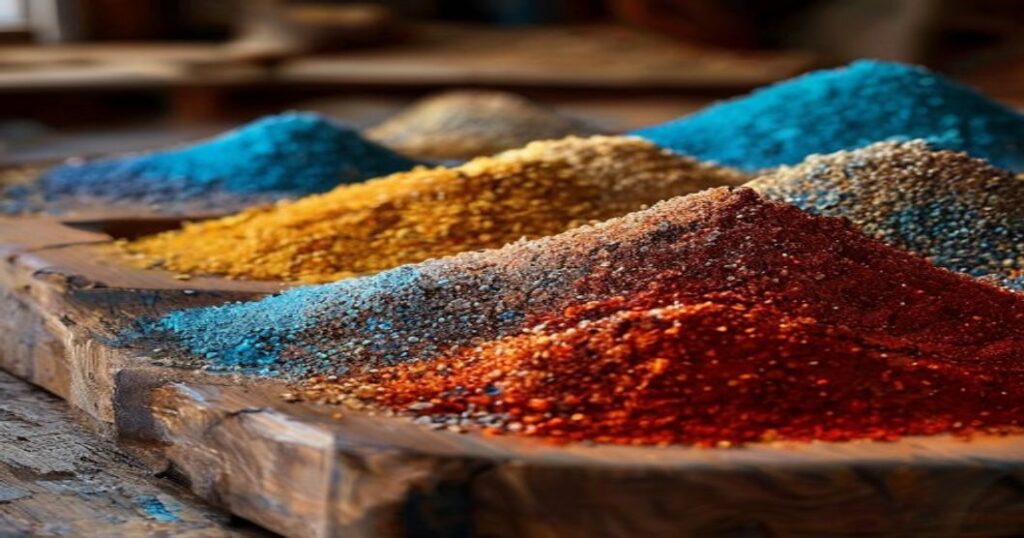
Everyone has seen colored sand. In glass jars at the beach town souvenir shop. Inside hourglasses. Inside kids’ craft kits. In moving sand pictures. In the Tibetan Buddhist mandalas that take weeks to make.
Almost no one has thought about where it comes from.
Which is a shame, because the answer turns out to be genuinely interesting. Natural colored sand exists, and in surprisingly rich palettes. Humans have been dyeing sand for thousands of years, using techniques that have evolved from ancient mineral pigments to the modern industrial processes that supply the global art-and-craft market. And the sand inside a well-made moving sand picture is a specific kind of colored sand, engineered for particular properties, that isn’t the same as what fills a hobby-shop kit.
This post is a tour through the whole strange world of colored sand.
Natural Colored Sand
Let’s start at the beginning. Not all sand is beige.
Sand is, technically, any granular material between 0.0625 mm and 2 mm in diameter — a size class, not a mineral. What you think of as “sand” on most beaches is mostly quartz (silicon dioxide, SiO₂), which happens to be abundant, hard, and pale. But depending on the local geology, the “sand” at any given location can be made of almost any mineral that’s been broken into grains.
And different minerals have different colors.
Black sand beaches exist wherever volcanic basalt has been ground by waves. Iceland has famous ones. Hawaii’s Punalu’u beach is black sand. Some beaches in the Canary Islands. The mineral is mostly basalt and magnetite; the color is real and permanent.
Green sand is rarer, but real. Papakolea Beach in Hawaii is one of the world’s only green-sand beaches — the green comes from olivine, a volcanic silicate mineral that weathers out of eroding cinder cones. Under a microscope, green-sand grains are translucent olive-green gems.
Pink sand appears on certain Bermudian and Bahamian beaches, where eroded red coral and the shells of foraminifera (single-celled marine organisms with red coral-colored tests) mix with white calcium carbonate. The result is a soft rose color.
Purple and red sands exist in parts of California (Pfeiffer Beach’s famous violet sand, from manganese garnet) and elsewhere.
White sand is usually made of eroded coral and broken shells (on tropical beaches) or pure quartz (in places like Destin, Florida).
Singing sands of the Gobi Desert are actually pale tan, but the “singing” is a separate phenomenon caused by the specific grain shape and size producing an audible vibration when they avalanche.
The existence of natural colored sand is why the early human traditions of making art with sand weren’t as extraordinary as they might sound — people had access to real pigmented grain in many places.
Historical Colored Sand: Mineral Dyes and Plant Extracts
For thousands of years, sand used in ritual and decorative contexts — particularly in South Asian and Indigenous American traditions — was colored using mineral pigments and plant-based dyes.
Navajo sand painting, practiced in ceremonial medicine contexts, traditionally used five colors: white from ground gypsum, yellow from sandstone or ground yellow ochre, red from red sandstone or iron oxide, black from crushed coal or charcoal, and blue (a later addition) from ground turquoise or azurite. The sand grains were sized and shaped deliberately for the specific pictorial requirements of the healing work.
Tibetan Buddhist sand mandalas — the dul-tson-kyil-khor — use crushed colored stone: powdered turquoise, lapis lazuli, coral, cinnabar, yellow ochre, and various other mineral sources. Traditionally these were pulverized by hand, with each monastery maintaining its own stock of raw material. Modern mandalas increasingly use commercially-dyed quartz sand to reduce cost and preparation time, though the practice of hand-grinding mineral pigments is still maintained in some temples.
Indian rangoli and related traditions use similar mineral or dried-plant-based colors — turmeric for yellow, crushed marigold for orange, ground leaves for green, indigo for blue, various iron oxides for red.
The common thread across all these traditions: the pigments are intimately tied to the material world they come from. The yellow is actual yellow ochre. The blue is actual lapis. The color isn’t a label on a package — it’s a specific mineral, with a specific weight, texture, and flow behavior.
Modern Commercial Colored Sand
The sand in the glass jars at souvenir shops is made in factories, and the process is straightforward if you know what to look for.
The base. Almost all commercial colored sand starts with pure quartz sand, selected for grain size uniformity and chemical cleanliness. The sand is washed to remove organic contaminants and silt, dried, and sorted (via mechanical sieves) into uniform grain-size batches.
The dye. The most common commercial colorant is a pigment mixture — either a water-based inorganic pigment (iron oxides for yellows and reds, chromium oxide for greens, ultramarine or cobalt for blues) or a resin-binder system that fuses the pigment to the grain surface.
The resin systems dominate the craft market because they produce brighter colors and better wash-resistance. A typical process: quartz sand is tumbled in a rotating drum with a pigment-and-resin solution. As the drum rotates, the resin coats each grain and the pigment adheres. The sand is then cured (heated or air-dried) so the resin hardens, permanently locking the pigment onto the grain surface.
Inorganic pigments. For higher-grade applications — scientific demonstrations, professional art supplies, museum-grade sand for conservation uses — inorganic pigments without resin binders are preferred. These are usually fired onto the grain at high temperature (similar to ceramic glazing) for permanent chemical bonding. More expensive, more colorfast, feels better to the hand.
Food-grade colored sand. Specialty markets — terrarium suppliers, aquarium suppliers, and Indigenous ceremonial-supply houses — sometimes offer food-grade or reef-safe versions, made with non-toxic, non-leaching pigment systems to avoid harming living things.
The choice between these production systems has real consequences for the finished product. Cheap resin-coated sand (the kind that shows up in children’s craft kits) has a slightly plasticky feel in the hand, can fade in direct sunlight over years, and doesn’t flow quite as well as natural-feeling sand. High-grade fired or naturally-pigmented sand flows beautifully, holds color indefinitely, and is what you’d want in any serious application.
The Sand in Moving Sand Pictures
Here’s the specific part relevant to the craft I work in.
The sand used inside a moving sand picture has a set of requirements most other applications don’t share.
Grain size uniformity. Every grain in the frame has to flow at a similar rate through the viscous liquid medium. Variation in grain size produces variation in flow speed, which disrupts the layered settling patterns. Industry standard is to use a tightly-sorted sand graded to a narrow size band.
Grain shape. Rounded, sub-spherical grains flow more smoothly than angular ones. Most sand used for moving sand art has been tumbled or selected from naturally rounded sources. Angular grains produce less-elegant flow.
Density. Different colors have to have carefully matched densities or they separate unevenly during settling. If one color is significantly denser than another, it sinks first, and the picture always produces the same layered outcome. A good moving sand picture uses sand with matched specific gravities so the colors interleave more richly during flow.
Pigment permanence. The sand is bathed in glycerin-water liquid for the life of the piece (decades, potentially). Pigments that leach into the liquid clog the physics and cloud the visibility. The sand in a well-made piece uses fired inorganic pigments that will never leach.
Color selection. This is where the artistry comes in. The colors are chosen to be landscape-coherent — a palette that, when mixed by the flow, looks like something (desert, sea, stone) rather than random. My own piece, the deep-sea sandscape, uses three colors — a deep oceanic blue, a warm amber, and a white — chosen to mimic the look of underwater sediment deposits under soft light.
For the piece I make in my workshop (here it is), the sand is sourced from a supplier that specializes in scientifically-graded colored quartz — the same material used in certain geology demonstration kits and museum displays. It’s considerably more expensive than the resin-coated hobby sand found in craft stores, which is why most mass-market sandscapes use cheaper material and the results are correspondingly visible.
How to Tell Good Colored Sand From Bad
If you want to compare for yourself, here’s what to look for in a handful of sand (or in a sandscape).
Sun-fade test. Leave a teaspoon of sand in a sunny windowsill for a month. Good sand holds color completely. Cheap resin-dyed sand visibly fades.
Water rinse. Rinse a spoonful in warm water. Good sand doesn’t stain the water. Cheap sand does, noticeably.
Weight. Heft it. Quartz is denser than you’d expect. Resin-coated cheap sand is often slightly lighter because the resin adds volume without much mass.
Feel. Pour some through your fingers. Good sand feels crisp. Cheap sand feels slightly waxy or plasticky.
Close inspection. Under a magnifying glass, good colored sand shows translucent grains with permanent color throughout. Cheap sand shows opaque grains with visible surface coating, sometimes with slight pigment accumulation between grains.
The Quiet Legacy
There’s one more point worth making.
Colored sand is one of the oldest artistic media humans use. Thousands of years of ritual sand painting, ceremonial mandalas, rangoli, sand casting, glass coloring, and craft traditions rest on human engagement with this specific material. The fact that we can scoop up colored particles and make pictures with them is one of the quiet threads running through human art history.
Every time someone flips a moving sand picture on a shelf, they are — in a small way — participating in a tradition that stretches back through Navajo medicine ceremonies, Tibetan monasteries, Hindu festival courtyards, and every other culture that figured out, independently, that sand could be made beautiful and then arranged into something meaningful.
The physics is straightforward. The craftsmanship is real. The lineage is deep.
Which is, I think, more than you’d usually expect from the stuff that fills a little glass frame on your shelf.
Vee Sharma — designer, founder of Moving Sandscape, and writer of these essays. Our flagship piece is the deep-sea sandscape; you can read more about how I think about this work on the about page.