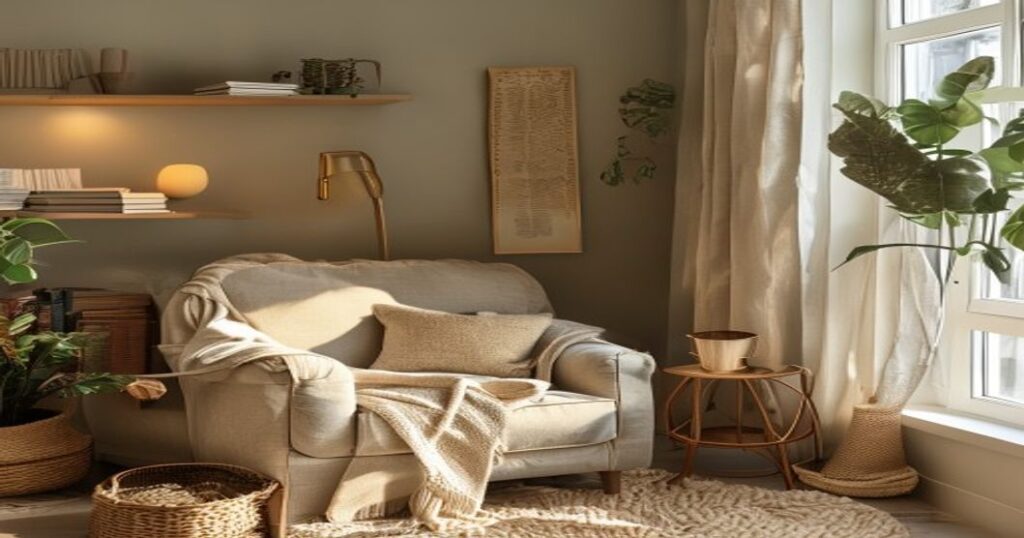
The idea of a “calm corner” has been circulating in interior design magazines and wellness blogs for a decade now, but most of the advice makes the same mistake. It assumes you have a spare room, or a sun-drenched bay window, or a walk-in closet you can convert into a meditation space. Most people don’t. The people who most need a calm corner at home are living in one-bedroom apartments, small houses with active families, or studio rentals where every square foot is already serving three purposes.
This guide is for them — and, honestly, for me, since I’ve built small calm corners in rentals as tight as 400 square feet. The principles are the same regardless of how much space you have. You need five specific elements, arranged in a particular way, with one or two decisions that separate a genuinely restful corner from a decorative one.
What follows is the working version of how I’d set up a calm corner if I had 40 square feet to work with, and then how the same idea scales up if you have more.
What a calm corner is actually for
Before we get to the how, let’s be precise about what a calm corner is. It is not a meditation room, a prayer room, or a therapy setup. It’s a small, deliberate part of your home where you can sit for ten to sixty minutes with no task in front of you — no screen, no chore, no conversation you need to have — and have your nervous system settle.
The reason to build one is that most of us have no such spot in our current homes. The couch is where the TV is. The bed is where sleep is. The kitchen is where food and chores happen. The desk is work. There is no remaining zone in the house that’s specifically for not doing anything, which is, paradoxically, one of the most important activities for a functional human.
A calm corner solves that. It’s a 15-square-foot carve-out that says, implicitly: this is where I come to not be busy.
When done well, it gets used. When done badly, it becomes a pretty-looking spot you walk past.
The five elements every calm corner needs
After building three of these for myself and helping friends build others, the pattern has become clear. A good calm corner has five specific elements. Leave any of them out and the corner underperforms.
A comfortable seat. The one non-negotiable. A chair, a floor cushion, a window bench, or a dedicated corner of the couch. The seat needs to be actually comfortable for 30+ minutes without repositioning. Test it — sit there for half an hour with a book. If you fidget, it’s not the right seat.
A warm light source that’s separate from the room’s main lighting. A dedicated floor lamp, a table lamp, or a wall sconce. Warm bulb (2700K), dimmable if possible. The light should be lower than the room’s main ambient light — the calm corner should feel like a pool of softer light inside the larger room.
A surface — small but real. A side table, a stool, a wide windowsill, or a built-in ledge. Somewhere to put a mug, a book, a candle. The lack of a surface is the #1 reason calm corners fail in practice: there’s no place to put the tea, so the chair ends up not getting used.
A sensory anchor. One non-visual element. A candle, a diffuser, a wool blanket, a ceramic mug that retains heat, an incense holder. The anchor gives your body something to do while the mind drifts — holding a warm mug, feeling the weight of a blanket, smelling something gentle. Without it, the corner becomes purely visual and doesn’t engage the body.
A focal-point object. Something your eyes can rest on. A plant, a piece of art, a window looking at a tree, a fireplace, a moving sand art frame. This is the soft-fascination target — the object that catches your attention briefly and restores it.
Those five elements, arranged in any combination of actual furniture, are what make a calm corner work. The style is negotiable. The five functions aren’t.
How to choose the right corner of your home
Not all corners are equal. Some locations reliably produce calm corners; others fight you the whole way.
The best locations share three qualities. They have some natural light — not necessarily full sun, but a window within a few feet. They’re out of the primary traffic flow — you’re not going to be interrupted every ten minutes by someone walking through. And they’re physically partitioned in some way — a corner, a nook, a wall behind you, a piece of furniture between you and the rest of the room. Being visually backed by something stable (not floating in the middle of a room) is a nervous-system cue that this is a safe place to settle.
If you have a spare room, use it. But most people don’t, and the next-best options in a smaller home are:
A corner of the living room, furthest from the TV, with the chair angled away from the screen.
A window seat if you have one — built-in or just a chair pulled up to a window.
A wide, deep windowsill in a bedroom that you convert into a cushioned bench.
A small landing at the top of a staircase.
A corner of a bedroom with the chair placed between the bed and the wall.
An unused dining room corner, with the dining table pushed slightly to accommodate a chair.
A corner of the kitchen — yes, really — with a small stool and a wide windowsill, if your kitchen has a quiet corner with morning light.
The worst locations for a calm corner are in the middle of a high-traffic zone, in a kitchen near the stove, or in any spot that’s directly facing a TV or computer. The nervous system can’t settle in a place where it expects interruption.
The anatomy of a 40-square-foot calm corner
Let’s make this concrete. Here’s how I’d set up the smallest viable calm corner — the kind you can fit into a rental apartment corner.
In a 5×8 foot area, place a single comfortable armchair or a deep oversized beanbag-style chair against the corner, angled so you’re looking out at the room or toward a window rather than at a wall. The back of the chair should be against the wall or a piece of furniture — never floating.
To the right or left of the chair (depending on whether you’re right- or left-handed), place a small side table — round, tall enough to reach from the chair without leaning forward. Marble, wood, or ceramic top. About 18–22 inches tall.
On the side table, place a small reading lamp (a “puck” lamp, a ginger-jar style table lamp, or a slim modern task lamp with a warm bulb). Directly next to it, have room for a mug or a candle.
Behind the chair or immediately next to it, place a tall plant — a fiddle-leaf fig, a monstera, or a potted bay laurel. The plant frames the space and signals “this is a living corner,” not just a utility spot.
On a nearby wall or shelf, place a focal-point object — a framed piece of art, a small moving sand art picture on a stand, or a collection of three small objects. Positioned so that when you’re sitting in the chair, your eye naturally lands on it between reading or daydreaming.
Across the back of the chair, drape a real wool or linen throw blanket. Not a thin polyester blanket — something with weight and texture. This is the tactile anchor.
On the side table, keep a beautiful, heavy ceramic mug permanently in rotation. The mug lives on the table; it’s the thing you pick up when you sit down. Heat some tea, sit, hold mug, exhale.
That’s it. Seven items. Total cost, if you shop carefully, is under $400 for a complete setup. Probably a lot less if you thrift or already have some of these items.
The specific role of the focal-point object
Of the seven items above, the one most people underestimate is the focal-point object. Let me spend a minute on why it matters.
When you sit down in a calm corner, your mind doesn’t immediately settle. For the first two or three minutes, it’s processing everything you’ve just come from — the call you just finished, the task you just stopped doing, the small irritation from earlier. During those minutes, your eyes are looking for somewhere to land.
If there’s nothing to land on — just a blank wall — your eyes drift toward the phone in your pocket. If there’s a TV visible, they drift toward the TV. If there’s clutter on a nearby surface, they start mentally organizing the clutter. None of these is a settling activity.
A focal-point object gives the eye somewhere to go that’s neither demanding nor empty. The plant, the art, the window, the sand art frame — the eye lands there, watches for a few seconds, drifts away, comes back. Within three or four cycles of this, the mind is quieter and the body has noticed.
A moving sand art picture is particularly well-suited to this role because it gently changes — if you flipped it when you sat down, sand is still falling for the first several minutes of your sit, which gives the eye an evolving scene rather than a static one. A plant works for the same reason over longer periods: new leaves unfurl slowly, the light through the leaves moves with the sun. Anything that rewards repeated glances without demanding them is in the right category.
Framed static art works but is slightly weaker — the first few times you sit, your eye processes the image; after a month of sitting, the image is familiar enough that your eye skips past it. Rotating between two or three pieces in the same spot solves this.
Things to deliberately not have in a calm corner
The five-element rule is a positive one — what to include. The negative rule is equally important. A calm corner is sabotaged by certain items that seem fine but quietly undermine the whole purpose.
Any screen. TV, computer, tablet, phone dock. The calm corner needs to be screen-free, full stop. Place it where no screen is in your peripheral vision when you sit down.
Work surfaces or work adjacency. The calm corner cannot be “the chair I sometimes use when I need to concentrate on email.” Mixing work and rest in the same physical spot confuses the nervous system’s expectations of what to do there.
Clutter storage. It’s tempting to let the calm corner be where you put the mail, the books you haven’t read, the laundry you haven’t folded. Don’t. The corner’s visual simplicity is what makes it work. Even small clutter destroys the signal.
Exercise equipment visible from the chair. The yoga mat rolled up in the corner, the resistance bands hanging on the wall. Visible exercise reminders activate a small stress response — “I should be doing that” — and work against what the corner is for.
The reading pile you’ve been avoiding. This is subtler than it sounds. If you put a stack of books next to the chair that are all books you’re “supposed to read” rather than books you actually want to read, sitting down carries a small guilt. Keep the visible books ones you genuinely look forward to. The rest go on a bookshelf in another room.
Anything with a timer. No phone, no clock with visible second hand, no countdown timer. Time should fade in the calm corner, not be measured.
How to use a calm corner so it actually gets used
The biggest failure mode isn’t building a bad calm corner — it’s building a fine one that nobody uses.
A few practices that help.
Assign a specific hook for sitting down. A post-work ten minutes before dinner. A morning fifteen before anyone else is up. A Sunday-evening reset hour. Without a hook, the corner becomes aspirational rather than used.
Keep the tea ritual minimal. If making tea takes fifteen minutes, you’ll skip it. Keep a kettle nearby, a tin of good loose-leaf or a box of bags within reach, and the mug permanently on the side table. The closer to “sit down, pick up mug” the ritual is, the more it happens.
Leave a book there, open to where you left off. Your current reading book, not an aspirational one. Bookmarked or facedown. The sight of a half-read book with a ribbon in it is itself an invitation to pick up where you left off.
Start with 10 minutes. Don’t try to sit for an hour the first few times. Ten minutes, no phone, with a mug and a book. Once that’s a habit, twenty becomes easier. Most people can reliably do ten; very few can reliably do an hour without a learning curve.
Don’t force “mindfulness.” The calm corner isn’t for formal meditation. It’s for unstructured rest. You don’t need to be “present” or “grounded” or doing any specific mental practice. Just sitting with a warm mug and occasionally looking up is the whole protocol.
When you can’t dedicate a corner: the portable calm zone
Not everyone can carve out 40 square feet. If you live in a studio, share a bedroom, or have a space that has to serve multiple daily functions, a portable version of the calm corner still works.
The principle is to keep the five elements in a designated box or basket, and deploy them on the same chair or cushion at the same time each day. The chair is shared; the transition to calm-corner mode is what you control.
In a small wooden box or woven basket, keep: a folded wool throw, a specific ceramic mug, a candle in a short jar, a small moving sand art frame (the 7-inch size works perfectly for this), a book or two, and a pair of wool house slippers.
When it’s calm-corner time, bring the box out, deploy the items on and around your chosen chair, dim the lights, and sit. When the time is up, the box goes back on the shelf.
This version looks less Instagrammable but works just as well. It’s also, counterintuitively, often more reliable than a permanent calm corner — because the act of setting it up is itself a signal to the nervous system that rest is about to happen.
Frequently asked questions
Do I need a window for a calm corner?
A window helps enormously but isn’t strictly necessary. If you don’t have access to one, compensate with warm lighting, a thriving plant under a grow bulb, and a focal-point object that provides visual interest. The window’s function is mostly about natural light and outside views — you can substitute with a lamp and an interior focal point.
Can a calm corner double as a reading nook?
Yes — in fact, most good calm corners are, in practice, where you do your reading. The requirements overlap almost entirely. What distinguishes a calm corner from a pure reading nook is that you should be able to sit there comfortably without reading as well, just thinking or watching the light or holding a mug. If the chair is only comfortable when you have a book, it’s not quite a calm corner.
Is a calm corner the same as a meditation space?
Related but not identical. A meditation space is built for a specific practice — a cushion, a timer, sometimes a specific image or icon. A calm corner is for unstructured rest, which is a broader and less formal thing. Many meditation teachers suggest having both, if you have the space.
How much should I spend on setting one up?
Under $400 gets you a complete setup if you shop carefully. Thrifting the chair and the side table brings it well under $200. The most expensive item is usually the lighting or the focal-point object; everything else can be had inexpensively or from what you already own.
Can the calm corner be a shared space with a partner?
Yes, though the ideal is a space big enough for two seats angled slightly toward each other. If the corner only fits one, make it clear which of you “owns” it at which times — morning for one, evening for the other. Sharing without structure leads to nobody using it.
A small final note
Building a calm corner is one of the higher-return projects you can do in your home, and it’s one of the cheapest. For under the cost of a night out, you can build a spot in your apartment that will quietly improve every week for the next five years.
Pick the corner. Get the chair comfortable. Add the five elements. Start sitting.
If a moving sand art frame fits the focal-point slot in your corner, you can see ours at movingsandscape.com. The 7-inch size is ideal for a small side table or window ledge; the 12-inch works well on a wall shelf or a larger sideboard next to the chair.
Vee Sharma — designer, founder of Moving Sandscape, and writer of these essays. Our flagship piece is the deep-sea sandscape; you can read more about how I think about this work on the about page.