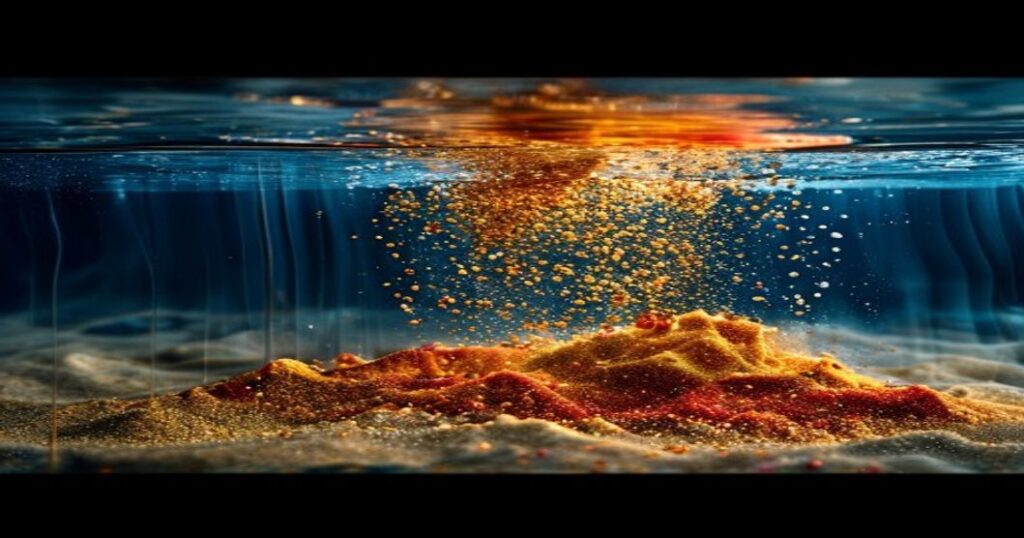
Some inventions arrive fully formed from a laboratory. Moving sand art did not. The object you might now have on a desk or a bookshelf — colored sand suspended between two panes of glass, water and air filling the gaps, the whole thing reshuffled every time you flip it — arrived through a combination of a Swiss physicist’s curiosity, a slight technical miscalculation, and decades of patient refinement before it found its way into modern homes.
This article is the long version of what I usually have to compress into a paragraph: what actually happens inside one of these frames, why the sand falls in those impossible layered canyons, where the form came from, and why the object has kept a place on desks and shelves for more than forty years despite competing with every digital distraction ever invented.
It’s also, frankly, a love letter to a simple object — which I’m biased about, because I make them. But I’ve tried to keep the physics honest and the history accurate. What follows is the story of how sand, water, and glass became one of the most reliably calming objects you can buy.
What is moving sand art, precisely?
A moving sand art picture — sometimes called a sand timer picture, a sand landscape, a sandscape, or a Bösch picture after its inventor — is a flat, rectangular glass frame, usually between 5 and 16 inches on the longer side, filled with a specific combination of materials.
Inside the frame you’ll find three things. The first is colored sand — usually quartz or silica sand, dyed in varying proportions of two or three contrasting colors. The second is water, which fills most of the internal volume. The third is air, held at the top of the frame in a single large bubble plus scattered smaller bubbles. Nothing else. No motors. No batteries. No moving parts in the mechanical sense.
When you flip the frame — rotating it through 180 degrees so what was the top becomes the bottom — the sand begins to fall through the water under gravity. The air bubble, meanwhile, begins to rise. What happens next is the whole point of the art form.
The cascade: what actually happens when you flip the frame
Here’s the sequence. You flip the frame upside down and place it back on its stand. Gravity starts pulling the sand downward. But the sand is now separated from the bottom of the frame by a volume of water, and — crucially — by a column of air trapped at the top.
The sand begins to fall through the water, slowed dramatically by the water’s viscosity compared to air. Sand grains settle at the bottom in layers, arranged roughly by size and color — the denser, coarser grains settling fastest, finer grains last. But the sand doesn’t fall in a uniform sheet. Because the air bubble is rising through the sand at the same time, the bubble’s path disrupts the settling, carving channels and gaps. The air bubble seeks the path of least resistance upward, which through a densely packed column of suspended sand grains is never predictable.
The result is a landscape. Mountains and valleys, plateaus and overhangs, canyons and cliffs form in the bottom half of the frame while the top clears. Because the air bubble’s route is chaotic — technically, mathematically chaotic — the pattern is always different. No two flips produce the same sandscape, even if you flip the same frame two hundred times in a row.
The entire settling process takes between three and eight minutes depending on frame size, sand grain distribution, and water viscosity. Some frames are engineered to be much slower — the large 16-inch artistic pieces can take fifteen minutes for the final grains to settle. By the time the sand has stopped falling, the frame is a completed picture: layered canyon walls in rich colors, with the occasional bubble trapped in the strata like a geological inclusion.
Klaus Bösch and the accidental invention
The form was invented by Klaus Bösch, a Swiss physicist and sculptor, in the late 1970s and early 1980s. The story, as he told it in various interviews before his death in 2016, is that he’d been experimenting with layered colored sands in glass containers for sculptural purposes, and the first “moving” picture was a near-accident — a frame he’d made with slightly too much empty space inside, allowing the sand to shift when handled.
What he noticed was that the pattern of the sand after a slight jostle was more interesting than before. And the water he was using to suppress dust during fabrication, left in the frame during a test, turned out to produce patterns nobody had seen in a sculpted sand medium before. The water slowed the fall. The air bubble carved channels. And the specific rheology of sand falling through water — governed by a principle called Stokes’ Law for the smaller grains and by more complex granular-flow equations for the larger ones — produced, reliably, the layered cliff-face aesthetic that we now take for granted in these frames.
Bösch patented the technique and began producing the first generation of moving sand pictures in small numbers in Switzerland. They were shown in galleries. Collectors bought them. And for about fifteen years, they existed mostly as an art-gallery curiosity and a niche European collectible before the form started being reproduced more widely in Asia and the United States, eventually reaching the scale at which they’re now produced.
Bösch himself always insisted, correctly, that the best frames were the handmade ones where the sand composition, air-to-water ratio, and particle size distribution had been carefully tuned. Cheap frames tend to cascade too fast, settle too uniformly, or produce muddy mixed-color patterns instead of clean layers.
The physics, in slightly more depth
If you’ve read this far and want the physics without the math, here’s what makes it work.
Sand in water sinks because sand grains are denser than water — typical silica sand has a specific gravity around 2.65, meaning it’s more than two and a half times as dense as water. That density difference is what drives the fall. But water is about fifty times more viscous than air, so the fall is slowed down by two orders of magnitude compared to sand in an open-air hourglass.
At the grain-by-grain level, the speed each sand grain falls at is governed roughly by Stokes’ Law, which tells us the terminal velocity of a small sphere falling through a viscous fluid depends on the difference in density between the sphere and the fluid, the viscosity of the fluid, and the square of the grain’s radius. This means that coarse grains fall much faster than fine grains — hence the color layering that emerges as the cascade proceeds. Larger, heavier grains settle first; smaller, lighter grains drift down on top.
But the really interesting thing happens at the collective level. When a lot of sand is falling through water at once — and an air bubble is trying to rise through it in the opposite direction — the system becomes a granular flow problem, which is notoriously complicated. The air bubble’s path is a function of tiny perturbations in the sand column, which means it’s functionally unpredictable. This is why no two flips produce the same image: the initial conditions amplify.
The layered-canyon aesthetic specifically comes from the air bubble rising through partially-settled sand. As sand grains accumulate on the bottom, they form loose piles. A rising bubble destabilizes these piles locally, creating steep cliffs where sand avalanches down in miniature mass-wasting events. The result is that you get not a random heap but a structured, cliff-faced landscape — the same physics, at a microscopic scale, that carves real canyons in sandstone over geological time.
Moving sand art is, in other words, a geology lesson that runs in five minutes instead of five million years.
Why it’s so calming to watch
I promised honesty about the physics, so let me be equally honest about the psychology. The calming effect of moving sand art is real, but it’s not magical. It’s explained by two well-established strands of research.
The first is attention restoration theory, developed by Stephen and Rachel Kaplan in the 1980s and refined continuously since. The theory distinguishes between directed attention (the effortful focus we use for work) and soft fascination (the effortless, involuntary attention we pay to things like moving water, falling leaves, or a fire). Soft fascination actively restores directed attention. A slow, unpredictable, visually interesting object like a moving sand picture is an excellent soft-fascination target — your attention drifts toward it without effort, watches for a few seconds, and drifts away refreshed.
The second is research on fractal visual stimuli. Physicist Richard Taylor has spent two decades measuring how the brain responds to visual patterns with specific fractal dimensions — roughly, patterns that have detail at multiple scales, the way clouds or mountains or snowflakes do. Patterns with fractal dimensions in the range of about 1.3 to 1.5 — which corresponds to patterns like coastlines, tree branches, and, yes, sand cascades — reliably produce measurable reductions in physiological stress markers in observers. The “soft chaos” of a moving sand picture is squarely in this fractal sweet spot.
Neither of these is exactly “science proves sand art makes you calmer” in a direct causal sense. But both explain why the specific aesthetic of a slowly-falling, layered, unpredictable sand pattern feels genuinely restful, and why the effect holds up better than many engineered calming products.
The form reaches scale — and splits into good and bad versions
After Bösch’s original production, the form spread through two channels. Art galleries continued to show individual artists’ work, often in larger formats and with unusual sand compositions. A handful of boutique producers in Germany, Switzerland, and later the United States kept making carefully tuned pieces with varied color palettes and sizes.
The second channel was mass production, mostly originating in Asia, which produced millions of frames at much lower prices but with significantly more variability in quality. A well-tuned mass-produced frame can be excellent; a badly-tuned one can be disappointing, with sand that falls too fast, air bubbles that clump, or muddy mixed-color patterns instead of clean layers.
The difference comes down to a handful of variables that matter more than they seem: the exact particle size distribution of the sand, the proportions of each color, the water-to-air ratio, the viscosity of the water (some makers add small amounts of glycerin to slow the cascade), and the construction of the internal glass baffles that keep the sand from shifting during transport. A frame where all of these are tuned produces a pattern that looks genuinely sculptural. One where they’re not produces something closer to a novelty.
What to look for in a good piece
Since this guide is for someone who might end up buying one, here’s what actually matters when you’re evaluating a moving sand art frame.
The first thing to look at is the cascade time — the time from flip to “fully settled.” A good frame should take at least three to four minutes for the majority of sand to settle, and up to ten minutes for the finest grains. A frame that fully settles in under 90 seconds is falling too fast to produce the fine layered detail that makes the form interesting. It’ll still work, but the sand-watching experience will be brief rather than meditative.
The second is color clarity. Each color band should stay distinct through the cascade. If all the colors mix into a muddy sludge after a flip, the water is over-saturated with fines or the color pigments were badly bonded to the grains.
The third is the air bubble behavior. A well-tuned frame has a single large air bubble that rises slowly and predictably enough to carve varied channel patterns. Frames with too many small bubbles produce chaotic, less interesting patterns. Frames with too little air settle uniformly, without the cliff faces that give the form its character.
The fourth is framing and quality of construction. A good frame is sealed well enough not to leak, rigid enough not to flex, and heavy enough to sit stably on a shelf or stand. Cheap frames develop small air-seal leaks over time that change the air-to-water ratio and gradually ruin the cascade.
At Moving Sandscape we make two sizes — 7-inch for desks and 12-inch for shelves and coffee tables. I’m obviously partial, but we tune the cascade time for a long, slow fall and pay attention to color layering specifically because it’s what I wanted in a frame when I first started looking for one and couldn’t find a reliably good version.
Where to put one
Since these are meant to be looked at occasionally — not stared at — placement matters more than for most decor objects.
A desk is the most common home, where the frame sits in your peripheral vision and catches your eye when you look up from the screen. A bookshelf works especially well if there are books on either side for visual weight. A mantel or a low shelf in a living room puts the frame where it can be noticed but not stared at. Coffee tables work for the larger 12-inch pieces, which act as low-level focal objects in a seated conversation space.
Avoid putting them somewhere where you’ll be constantly turning to watch them while trying to do other things — that defeats the soft-fascination purpose and turns them into distractions.
Frequently asked questions
How long does a moving sand art frame last?
Well-made frames last decades. The sand doesn’t degrade, the water stays clear if the frame is properly sealed, and there are no moving parts to wear out. Cheap frames can develop air-seal leaks in two to five years, which slowly changes the cascade. Good frames from reputable makers routinely last 20+ years without degradation.
Does the water in a moving sand art frame evaporate?
In a properly sealed frame, no. The glass-to-glass seals are airtight and the water is trapped permanently. If you see the water level changing, the frame has a slow leak and will eventually need repair or replacement. Water level should be stable for the life of a well-made frame.
Can you refill or service a moving sand art picture?
Some high-end pieces are designed to be refilled, but most are sealed units. Because the specific tuning of water volume, air volume, and sand distribution determines the cascade behavior, refilling a frame is a precision operation and usually worth doing only for particularly valuable pieces.
Is moving sand art the same as a sand pendulum or sand table?
No. A sand pendulum is a hanging weighted object that draws patterns in a sand tray as it swings. A sand table uses a motorized steel ball rolling through sand under a glass top to draw patterns continuously. Both are closely related in spirit but use very different physics. Moving sand art specifically uses gravitational settling of sand through water with a rising air bubble, and requires no motors or moving parts.
Does moving sand art have any health claims attached?
Reputable makers don’t make explicit health claims, because the research on calming objects is about categories (soft-fascination visuals, fractal imagery) rather than specific products. What is true is that watching slow, unpredictable visual motion has been consistently associated in research with short-term reductions in physiological stress markers. Whether that adds up to meaningful “health benefit” depends on how you define the term. What it does, reliably, is give the eye a place to rest that isn’t a phone.
A small final note
The reason this object has stuck around for more than forty years, in a period when almost every other home decor form has been invented, digitized, and forgotten, is that it does one thing no digital alternative can quite match: it rewards your attention without demanding any of it back.
A screen saver can show you moving sand. An app can simulate it. But the physical presence of a frame on a desk — the specific weight of it, the specific sound of the sand inside when you flip it, the fact that it changes without permission and then stops without permission and sits there looking beautiful — is something digital substitutes can’t quite reproduce.
If you want to see what a well-tuned frame looks like in person, you can browse ours at movingsandscape.com. I’m biased, obviously. But I think it’s one of the rare objects that genuinely deserves the second and third glance.
Vee Sharma is the founder of Moving Sandscape and writes most of the essays on this site. The studio’s flagship piece, the deep-sea sandscape, has been in customer homes for several years now — gifted, displayed, and reflipped daily.