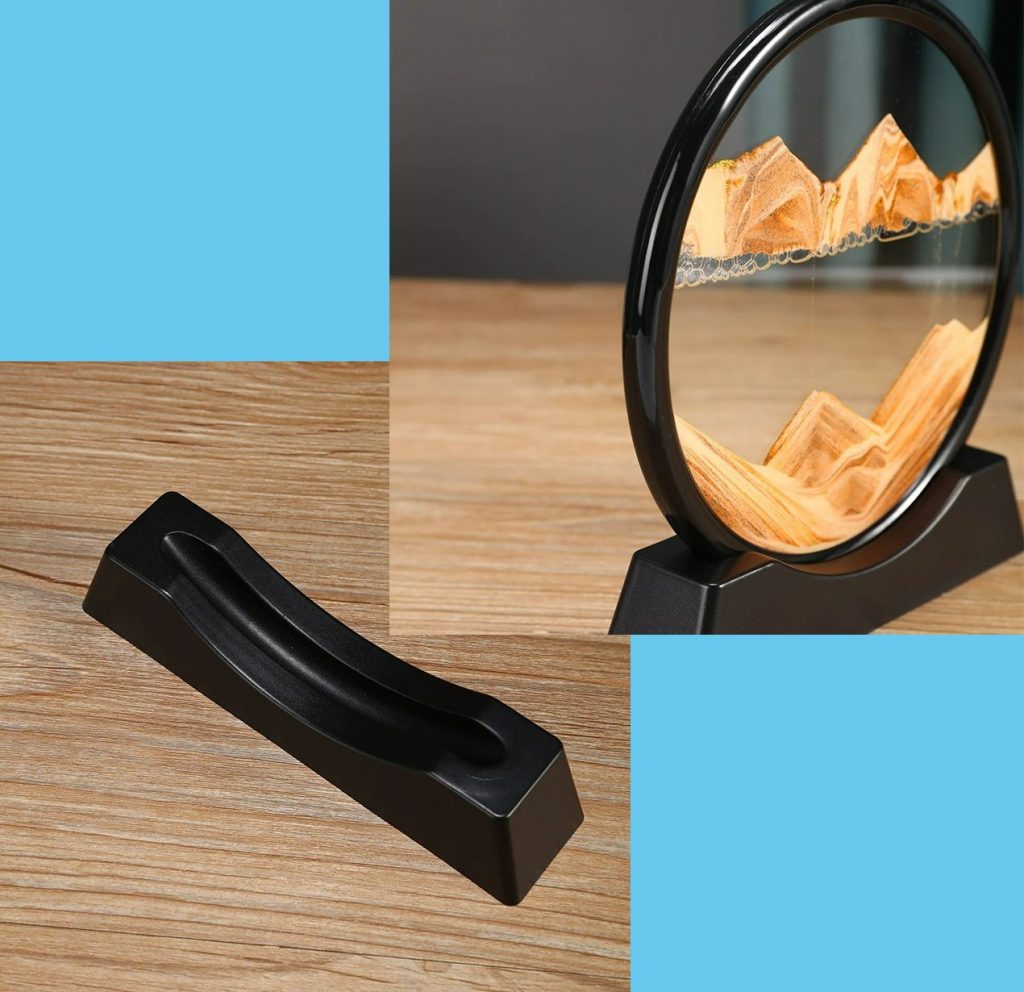
Hanging a moving sand art piece well is the difference between a lovely object that anchors a room and a lovely object that looks slightly out of place. The same frame on the same wall can feel central in one location and afterthought in another. This guide walks through nine living-room placements that interior designers consistently reach for, with the reasons each one works and the rooms each one suits.
The one rule that governs all the others
Before we get into specific placements, one principle that almost every designer we know follows: moving sand art wants to be seen from a seated position, not a standing position. Most living-room objects get looked at while you walk through — a painting in a hallway, a sculpture on a console. A kinetic piece is watched while you sit. That single observation changes almost every measurement.
Practical consequence: the centre of the piece should sit roughly 140–150 cm from the floor if you typically sit on a sofa, and about 125–135 cm if you use low lounge seating or a floor cushion. Most people hang art too high because museums hang it too high; a living-room kinetic piece hung at museum height will require an uncomfortable neck tilt every time someone sits down to watch it.
Placement 1: The centre of the sofa wall
The classic. Find the wall behind the sofa, measure from the floor to your seated eye line, hang the piece at that height. The piece becomes the visual anchor of the room. People who walk in look at the sofa, then at the piece behind it, and take the whole arrangement in as one composition.
Best for: formal living rooms; rooms with a single dominant sofa; compositions where you want a clearly read central focal point.
Watch out for: if the sofa is deep and the wall is close behind it, people seated on the sofa will not be able to watch the piece comfortably. In that case consider a different wall.
Placement 2: On the wall opposite the sofa
Often the best choice in a modern living room. The piece faces the seating group, which means everyone seated is also a potential viewer. This placement also works brilliantly above a low sideboard or media console, where the sand frame becomes an alternative to a television.
Best for: rooms where the sofa faces a wall that currently hosts a TV; open-plan living areas; homes where the owner deliberately wants the focal point of the room to be something other than a screen.
If you already have a television on the opposite wall, you can either replace it with the piece (some of our customers do this and report they simply watch less TV as a result), or hang the piece above or to one side of the TV with a small gap so both objects can be viewed but only one at a time.
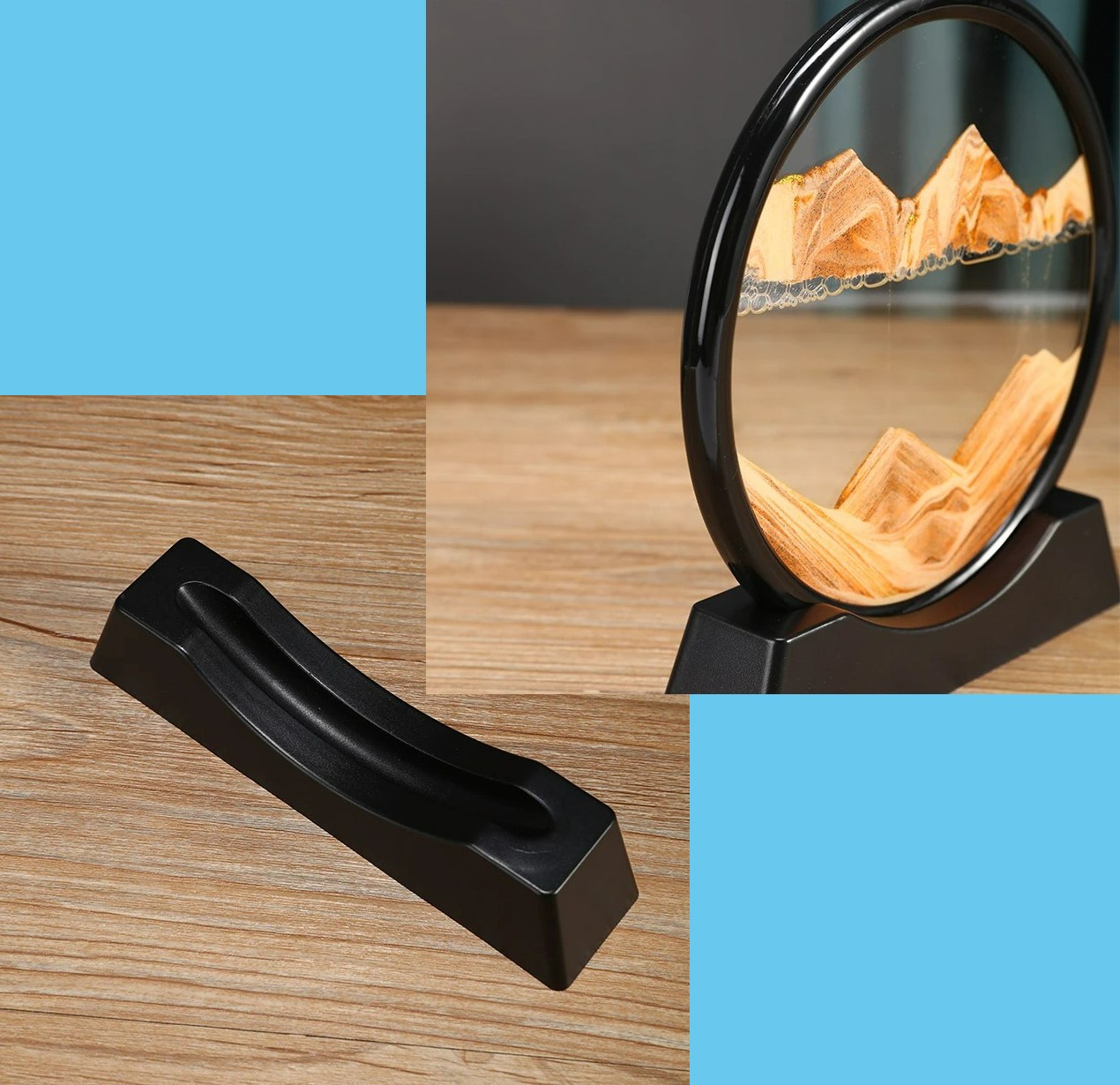
Placement 3: Above the fireplace
The fireplace mantle is a traditional focal point and a natural home for a kinetic piece, with one important caveat: heat and sand art do not mix. A working fireplace that regularly runs produces a strong updraft of warm air that can, over years, discolour sand or damage wooden frames. If your fireplace is purely decorative, this placement is excellent. If it is a working wood-burner, hang the piece on an adjacent wall at the same height.
Best for: period homes with decorative mantels; rooms with non-functional fireplaces used as shelving features.
Placement 4: At the end of a reading nook
A reading nook — an armchair, a floor lamp, a small side table, a shelf of books — is one of the most underused opportunities for kinetic art. Hang the piece on the wall directly opposite the reading chair at seated eye height. While you read, the piece sits in your peripheral vision; when you pause, you look up and watch it. This is the kind of small daily use that ends up mattering more than the grand display.
Best for: introverted households; homes where one family member uses a dedicated reading spot; small rooms where creating a small functional zone matters more than impressing visitors.
Placement 5: The bookshelf gap
A built-in bookshelf with a deliberately empty horizontal shelf at roughly seated eye height can host a moving sand art piece on a small base, rather than a wall mount. The piece sits among books, becomes the centre of the composition, and reads as part of the library rather than an art gesture.
This placement is particularly effective when the surrounding shelves hold a mix of books, objects, and empty space. Over-full shelves drown any individual object. Leave generous gaps on either side of the piece.
Placement 6: On a console table against a long wall
In rooms with a long, low console against a wall — often below a mirror, or in a hallway opening into a living room — placing the kinetic piece on the console creates a natural vignette. Combine with a small ceramic, a single stem in a vase, and ideally a pair of books lying flat. The piece anchors the vignette; the other objects supply scale.
Best for: transitional spaces; long walls that are not quite right for a single large artwork; homes that favour layered objects over single feature pieces.
Placement 7: In a gallery wall
A kinetic piece inside a gallery wall is a bold choice, and it can work beautifully if three conditions are met. First, the piece should be the largest element, or very close to it. Second, the other frames should be visually quiet — line drawings, photography, monochrome abstracts — so the sand frame remains the piece that moves. Third, there should be enough negative space around the piece that the other frames do not crowd it.
What does not work: a kinetic frame surrounded by busy, colourful prints of similar size. The piece loses its ability to be the slow thing in a composition full of fast things.
Placement 8: The “second seat” spot
This is one of our favourites and rarely discussed. If your living room has a second, less-used seat — an armchair, a window bench, a window seat — hang a kinetic piece where that seat can see it easily. What happens over time is that the seat gets used more often, because there is now a specific quiet thing to do there. The piece effectively activates an under-used corner of the room.
Placement 9: On a plant-rich wall
Biophilic design — the deliberate use of plants and natural imagery indoors — pairs well with kinetic sand art because the two objects work on the same underlying human preference for slow, natural-looking stimuli. Hang the piece on a wall where plants sit in pots on shelves or stands below it, or on a wall where a single large plant (a fiddle-leaf fig, a kentia palm, a tall dracaena) stands beside it. The piece reads as part of the botanical composition, and the plants soften the frame edges.
Best for: lofts and apartments with strong indoor-plant collections; sun-filled rooms where a little more natural material on the walls is welcome.
A few placements to avoid
- Directly above a radiator. Same reason as above a working fireplace — heat and water-filled frames are an unhappy pairing.
- In direct, full-day sunlight. Sand colours are designed to be colour-fast, but no pigment is perfectly stable in hours of direct sun over years.
- Behind a high-traffic door. If the piece is behind a door that swings open repeatedly, it will eventually get bumped. Choose a wall that is not on the door’s arc.
- On a shared wall with a loud appliance. Vibration from a nearby washing machine, large speaker, or subwoofer will, over time, affect sand settling. Pick a different wall.
One final thought
The placement that works is the placement you see from where you spend time. All the interior-design theory in the world is irrelevant if the piece ends up in a corner of the room you never turn toward. Walk through your living room for a full day, note where your eyes go most often when you sit down, and hang the piece there. The best spot is almost always somewhere you already look.