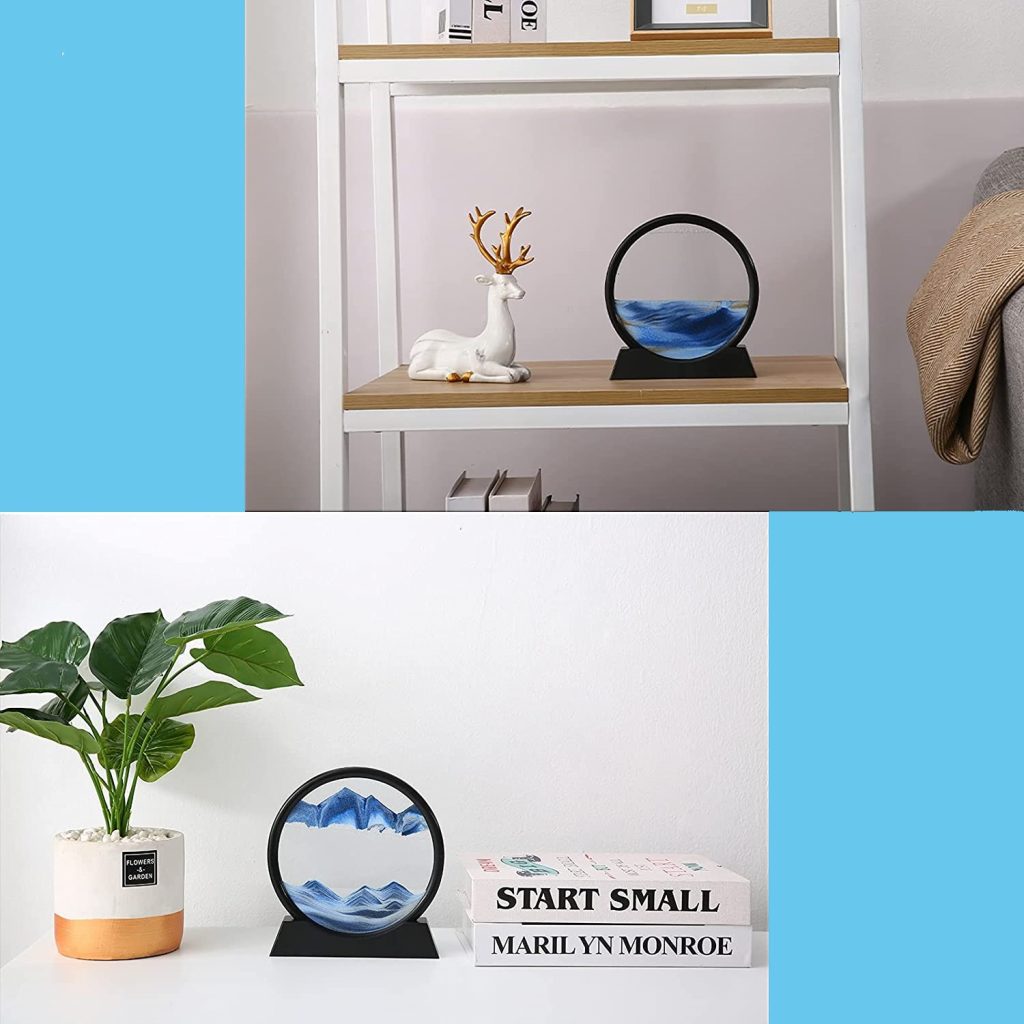
A home meditation corner does not need to be a separate room, an elaborate altar, or a large budget. It needs three things: a seat, a focal object, and an agreement with yourself that this particular square metre of your home is used for a particular kind of quiet. The rest is optimisation.
This guide walks through how to design a meditation corner that you will actually use. It covers layout, lighting, sound, the focal object (often, in our view, a moving sand art piece), seating, and the small invisible rituals that make the corner work over time.
Step 1: Choose the right square metre
The single most common mistake in home-meditation-corner setup is placing the corner somewhere beautiful but inconvenient. A north-facing window in a spare bedroom that you never enter will produce a lovely photograph and zero minutes of actual practice. You want a corner that sits on the path between two parts of your day. The best meditation corners are passed by in daily life — on the way to the kettle, on the way to bed, on the way to the balcony. You don’t want to have to make a special expedition.
The ideal square metre has three features: it is visible from where you already spend time, it does not get used for anything noisy or high-traffic, and it has a wall behind it. A wall behind gives you somewhere to hang a focal object at the right height, and gives your body a sense of enclosure that helps the nervous system settle.
Good candidates in most homes: a corner of the living room away from the main traffic flow; a landing at the top of the stairs; the corner of a bedroom closest to a window; a quiet end of an open-plan kitchen.
Step 2: Seating
You do not need a cushion on the floor. People who try to meditate on the floor when their bodies are not conditioned to sit that way tend to give up within two weeks, blaming the practice when the problem was really their knees. A comfortable chair with a reasonably upright back — kitchen chair, dining chair, armless lounge chair, small accent chair — works fine.
A floor cushion or meditation bench works well if you already sit on the floor regularly for other reasons. A wool cushion or a zafu of buckwheat hulls is comfortable for most sitters; a folded blanket in a pinch is fine.
What matters more than the type of seat: it lives in the corner permanently. If the cushion has to come out of a cupboard every time, it will not come out. If the chair is the same chair you also use for answering emails, the corner is not a meditation corner; it is an office with delusions.
Step 3: The focal object
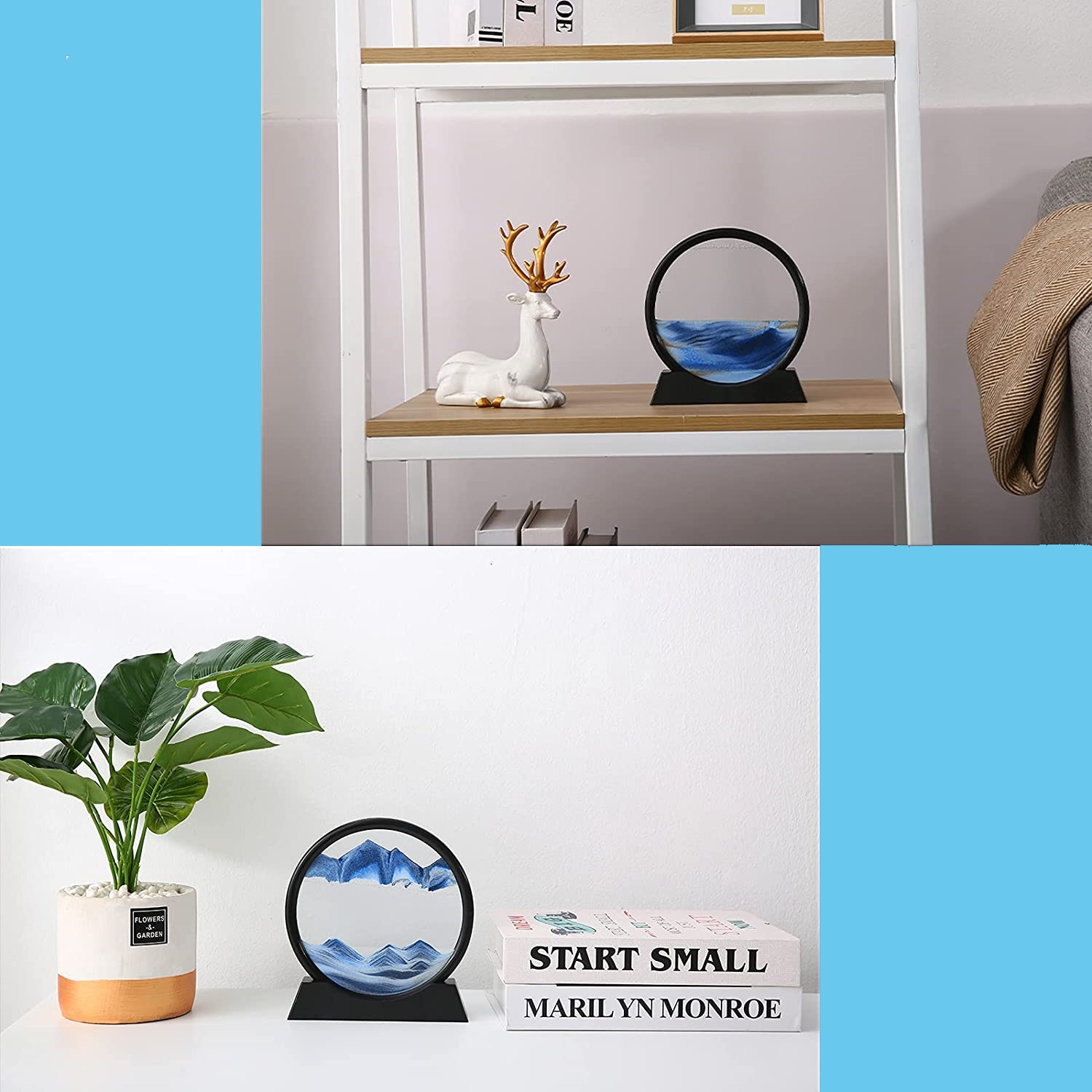
A focal object — something to rest the eyes on while the mind settles — makes beginner meditation considerably easier and advanced practice more consistent. The object can be a candle, a single plant, a carefully chosen print, a small statue, or a kinetic piece. Each has different strengths:
- A candle is the classic. It requires lighting, which is a small ritual in itself. Flames are slow, naturalistic, and compelling. They are also a fire hazard and cannot be left unattended.
- A plant is quiet and alive. It works well as ambient presence but is not dynamic enough to anchor attention on its own.
- A kinetic object — moving sand art, a sand pendulum, a slow water drop — gives you non-repeating motion to watch. This is closer to what practitioners in some traditions call trataka, a soft-gaze practice on a moving object.
- A single print or icon works for experienced practitioners who do not need motion to hold attention.
For most beginners, the kinetic object or the candle is the easiest starting place. A moving sand art piece has a practical advantage over candles in that you can leave it running unattended, and it does not need replacing.
Step 4: Lighting
Light matters more than most people assume. Three principles:
- No overhead ceiling light during practice. Overhead lighting is functional, not restful, and it makes every room feel like an office. Use a floor or table lamp with a warm bulb (2700K or lower). Many new meditation corners are ruined by a single bright ceiling fixture.
- Light the focal object, not the sitter. You want your eyes to find the object naturally. A small directional lamp pointed at the wall or shelf where the object lives does this beautifully.
- Natural light is fine but not required. A corner that practises only in daylight is a corner that practises inconsistently. You want the corner to work at 7am, at lunchtime, and at 10pm with equal ease.
Step 5: Sound
The default for a meditation corner is silence. Music, even gentle music, is a training wheel that becomes hard to remove later. Start in silence for your first month; you can always add sound later if you find it helps.
If your home is genuinely noisy — street traffic, neighbours, a busy household — a small white-noise or pink-noise source at low volume will mask the worst peaks without becoming a distraction itself. Avoid playlists, which demand attention and suggest that you are waiting for the next song.
Step 6: The small ritual objects
A meditation corner benefits from one or two small, specific ritual objects that are used only there. A single candle you light only during practice. A particular blanket you wrap around your shoulders only while sitting. A notebook that is only opened after the session. These small, dedicated objects give the corner a density of habit that a simply-furnished spot does not have. Over weeks, the ritual object begins to cue the nervous system that practice is starting, even before you sit down.
Do not over-furnish. One or two objects is plenty. A corner with fifteen small statues and twelve crystals is not a meditation corner; it is a display case.
Step 7: The clutter rule
Nothing else lives in the corner. No piles of laundry, no stack of books waiting to be shelved, no phone charger, no post. The corner is the only space in the house with a strict zero-clutter rule, and that rule is what makes it function. The eye needs somewhere to rest. If the corner becomes another surface that collects the debris of daily life, its effect evaporates almost immediately.
This is the single biggest predictor of whether a meditation corner survives past its first month: whether the household agrees that this one square metre is protected from the everyday drift of stuff.
A sample corner, from memory
One of our customers in a small city flat built a corner that has become a reference point for us. She cleared a corner of her living room that was formerly occupied by a laundry basket. Against the wall, she hung a moving sand art piece at eye height when seated. Below it, on the floor, she placed a small kilim rug and a wooden meditation bench. To one side, a floor lamp with a warm bulb. On the rug, a small ceramic dish holding a single river stone. Nothing else. She practises there for fifteen minutes most mornings and a flip-and-watch session most evenings, and has done so for two years. The corner still looks, on photograph day, exactly as it did when she set it up.
What makes a corner survive
The corners that stick are not the most beautiful ones. They are the ones with the lowest activation energy. You pass them, you notice them, you sit down, and five minutes later you stand up slightly different. The more steps between your current location and the corner — put this away, move this chair, light this candle, find this book — the less often you will practise. Design for a corner you use, not a corner you photograph.
If a kinetic piece is going to be your focal object, place it where it does not need re-flipping to be noticed. A wall-mounted frame with a wide base is ideal. You walk past, you flip, you sit. The practice is built into the room.