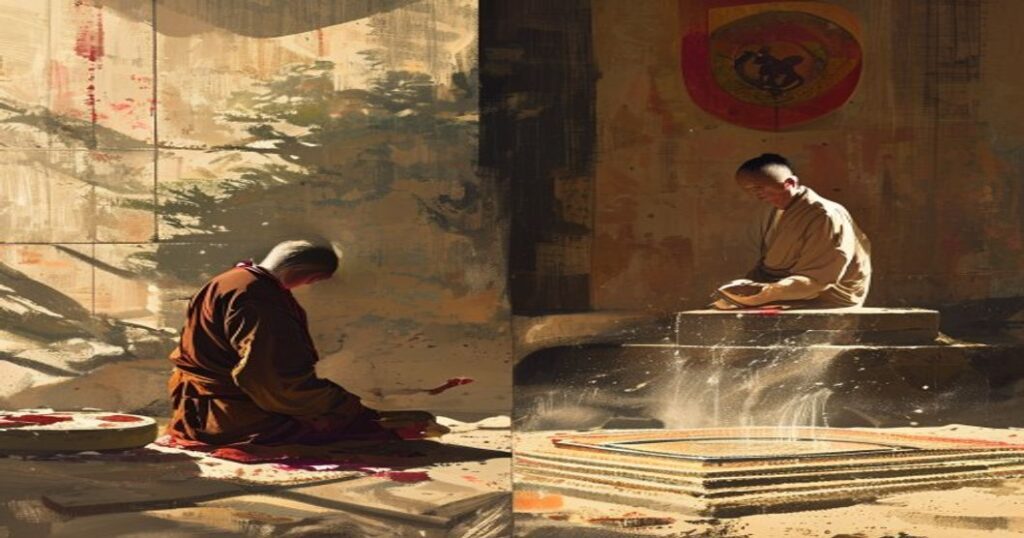
There is a strange and persistent thread running through several of humanity’s oldest contemplative traditions. The thread is sand.
Sand mandalas in Tibetan Buddhism. Karesansui zen gardens in Japan. Sand drawings in Indigenous Australian culture. Rangoli and kolam patterns in Hindu households. Sand paintings in Navajo medicine ceremonies. Across continents, across centuries, across radically different theological frameworks, humans have repeatedly chosen sand as the medium through which to express something about the nature of existence.
What unites these traditions, beyond the material, is impermanence. Sand is not a permanent material. It blows away. It can be raked into a different pattern. It can be ceremonially destroyed. It can be flipped, in the modern sealed form, and rearranged again. The thing about sand art — across all its traditions — is that it is made to be remade.
This post is an attempt to trace that lineage and to make a case that the modern moving sandscape sits, somewhat improbably, in deep continuity with these older traditions. Not because it is a religious object. But because it expresses, through its materials and form, the same essential insight: the impermanence is the point.
The Tibetan Sand Mandala
Begin in Tibet.
A dul-tson-kyil-khor — literally “mandala of colored powders” — is a sacred geometric design constructed from millions of grains of dyed sand by Tibetan Buddhist monks. The construction process can take days or weeks. Monks pour sand from narrow metal funnels called chak-pur, scraping the funnels to release single grains at a time, building up complex symbolic patterns of extraordinary precision.
The colors are traditionally produced from crushed minerals — turquoise for blue, lapis lazuli for darker blue, cinnabar for red, gypsum for white, charcoal for black, ochre for yellow. Modern mandalas often use commercially-dyed quartz sand for cost reasons, though some monasteries continue to grind their own pigments.
What makes the sand mandala distinctive — and what it’s most famous for — is what happens when it’s finished.
After the mandala is complete, after the days or weeks of meticulous work, after monks have invested staggering amounts of focused labor in the construction, the mandala is ceremonially destroyed. Monks sweep the sand into a single mass with their hands, gather it into a vessel, and pour it into a flowing river or stream. The careful pattern returns to formless particles, which return to flowing water, which carries them out to the sea.
The destruction is not an afterthought. It is the central teaching. The point of the entire elaborate process is to demonstrate, through the material itself, that nothing constructed lasts. The mandala exists, the mandala is beautiful, the mandala is gone. The hours of labor were not wasted; they were the point.
The Buddhist concept being expressed is anicca — the doctrine of impermanence — which holds that all conditioned phenomena are in constant flux, and that suffering arises from clinging to forms that cannot, by their nature, persist. The mandala is a meditation tool. The construction is a meditation. The destruction is the most important meditation of all.
The Japanese Zen Garden
Cross to Japan.
A karesansui (literally “dry mountain water”) is a Japanese rock garden, sometimes called a zen garden in English. The most famous example is the garden at Ryōan-ji in Kyoto: fifteen rocks arranged on a bed of carefully raked white gravel within a walled enclosure.
The gravel — which is technically not sand but coarse quartz crushed from local stone — is raked into patterns that suggest flowing water around the rocks. The rake leaves precise concentric or parallel lines. The patterns are not permanent. They are raked away and re-raked, daily or weekly, by the temple gardeners. The garden is in a state of constant slow remaking.
Karesansui emerged in the 11th-14th centuries in Japan, deeply influenced by Chinese Chan Buddhist (which became Japanese Zen) thought about contemplation and meditation. Unlike a sand mandala, which has a fixed completion and ceremonial destruction, the zen garden is in continuous re-making. The patterns shift over time. The same garden visited a year later will look slightly different. The patience and attention required to rake the patterns is itself a meditative practice for the gardeners.
What’s striking is how similar the underlying logic is to the Tibetan mandala. Both use particulate inorganic material (crushed stone or sand) to create temporary patterns. Both treat the making as more important than the made object. Both tie the impermanence of the patterns to a broader spiritual teaching about the impermanence of all things.
But where the Tibetan tradition uses dramatic completion and ceremonial destruction, the Japanese tradition uses continuous quiet remaking. Same insight, expressed differently.
Indian Rangoli and Kolam
Cross again, this time to South Asia.
In Hindu households across India — but especially in Tamil Nadu, Andhra Pradesh, Kerala, and other parts of South India — women traditionally draw geometric patterns each morning on the threshold of the home. The patterns are made from rice flour, colored powders, or sometimes rangoli sand (a fine colored mineral powder).
In the southern traditions (kolam in Tamil, muggu in Telugu, mandana in Rajasthan), the patterns are typically white powder on a swept floor or threshold. In the northern rangoli traditions, they often incorporate bright colored powders and more elaborate floral motifs.
The patterns are made fresh each morning. Over the course of the day, they are walked over, blown by wind, scattered. By evening, often, they are gone or significantly degraded. The next morning, a new pattern is drawn.
The cultural meanings are layered: the patterns are an offering to the deities, a welcome to visitors, a daily expression of beauty, a meditative practice for the woman drawing them. But again, the underlying material logic is the same: a temporary pattern in particulate material, made beautiful for its brief existence, accepted in its disappearance.
In some traditions, the rice-flour kolam is intentionally drawn so that ants and birds can feed on it during the day — the pattern is also a meal for the small creatures of the home. The impermanence is the ecological grace.
Navajo Sand Painting
Cross once more, to the southwestern United States.
The iikááh — sand paintings of the Navajo (Diné) people — are traditional ceremonial healing artworks. A medicine man (or Hatáłii) draws an elaborate symbolic painting using colored sand poured between fingers, representing specific stories, deities, and healing motifs from Navajo cosmology.
The paintings can be small or very large (some traditional ones were six meters or more across). The construction takes hours. The colors come from local mineral sources: ground gypsum, sandstones in various ochres, crushed coal or charcoal, and (in later traditions) ground turquoise.
Critically, the sand painting is not a piece of art for display. It is a healing instrument, used as part of a specific ceremony. The patient sits on the painting (or has parts of it placed on their body) so that the spiritual power of the design can transfer to them. After the healing ceremony, the painting is destroyed: scraped up, the sand returned to the earth in a specific direction, the materials neutralized.
The destruction is ritually mandatory. A sand painting cannot be preserved. Tourist sand paintings (sold for sale to outsiders) are intentionally drawn imperfectly — with deliberate errors, simplified patterns, and missing key elements — so that the spiritual integrity of the ceremonial form is preserved separately from the saleable craft form.
The same essential teaching: the work is meant to do its work and then dissolve. The making is the value. The vanishing is part of the design.
What These Traditions Have in Common
Five very different cultural and theological traditions, separated by oceans and centuries, all chose sand or sand-like materials for their most contemplative work. Why?
A few overlapping reasons.
Sand is universally available. Every culture has access to it. It doesn’t require complex technology to make or use. The basic medium has been ready-to-hand for as long as humans have been making things.
Sand is granular — and granularity invites pattern. Each grain is small enough that elaborate designs are possible, and large enough that the patterns are visible. The medium is naturally suited to the creation of fine, ordered structures.
Sand is impermanent. This is the central feature. Sand can be arranged but not preserved (without modern sealed containers). The medium insists on impermanence. You can’t make permanent sand art. The material itself teaches the lesson.
Sand is humble. Unlike paint, marble, or precious metals, sand has no commodity value. The art made from it cannot be sold for the value of its material. This frees the work to be about the act of making, rather than the value of the object made.
Sand connects to the body and to flow. The act of pouring sand from the fingers, raking sand with a tool, watching sand fall through space — all of these are deeply somatic. The material engages the hand and the eye. There is no buffer of brush or chisel between the artist and the material.
Together, these qualities make sand uniquely suited to a contemplative practice. Other materials can be permanent. Sand is honest about being temporary. That honesty is, across cultures, what made it the chosen medium.
The Modern Moving Sandscape
Here’s where I want to make the contemporary connection.
The moving sand picture — as Klaus Bösch invented it in the 1980s and as we (and a small handful of other workshops) make it today — is a sealed-glass artwork containing colored sand suspended in a viscous liquid. When the frame is flipped, the sand falls slowly through the liquid, forming a unique landscape pattern. Each flow is different. The settled landscape is then there, briefly stable, until the frame is flipped again.
In strict art-historical and theological terms, the moving sandscape is not a sand mandala or a karesansui or a rangoli. The lineage is not direct, and we shouldn’t pretend otherwise. The moving sandscape was invented as a beautiful object for the home, not as a religious instrument.
But there’s a structural resonance that I think is worth taking seriously.
The moving sandscape, like its older cousins, uses sand (specifically: graded, colored quartz) as the medium. The patterns it makes are temporary — they exist only between flips, and each pattern is replaced by a new one when the user chooses. The patterns cannot be preserved as patterns; they exist for a time and then are reformed. The material insists, by its nature, on impermanence.
The user’s role mirrors, in domestic miniature, the role of the monk pouring the sand mandala or the gardener raking the karesansui. The flip is the action that initiates the pattern. The watching is the contemplative engagement. The acceptance that the pattern will not stay — and that the next pattern will be different — is the same acceptance the older traditions cultivate.
I’m not making the larger claim that flipping a moving sandscape is equivalent to constructing a Tibetan sand mandala. That would be both inaccurate and a bit silly. Tibetan monks spend years training in the symbolic and meditative dimensions of mandala work; the work has theological weight that no living-room object can replicate.
But I do want to make a smaller and more interesting claim: that the form of the moving sandscape — the use of sand, the temporary patterns, the ritual flip, the contemplative watching — places it within a vast historical tradition of impermanent sand-based art. It belongs to that tradition, in a domestic-modern way.
When you flip a moving sandscape on your shelf and watch the colored grains start to fall, you are participating, in a small way, in something humans have been doing for thousands of years across many cultures. The act of making temporary patterns in sand, watching them, accepting that they are not permanent, and being okay with that.
The lineage is thin and the link is informal. But the link is real.
What I Take From This
A few personal reflections.
The first is that one of the most quietly powerful aesthetic experiences available to humans is watching something beautiful that you know will not last. The flowering cherry blossom, the sunset, the sand mandala, the candle burning down. There is a particular emotional register that things-known-to-be-temporary occupy. They land differently than permanent objects do.
The moving sandscape, in its modest way, is built to participate in this register. Each flip produces a landscape that’s beautiful for a few minutes and then is gone. You can flip again, but the new landscape will be different. There’s no archiving the previous one. Each is a small ephemeral gift.
The second is that impermanence-as-teaching is one of the deepest and most consistently arrived-at insights across human contemplative traditions. Different theological frameworks (Buddhist, Hindu, Indigenous American, Japanese Shinto-Buddhist syncretism, Daoist) arrive independently at the conclusion that working with impermanent material is a useful spiritual practice. They can’t all be wrong about this.
In the modern Western context, where most of our objects are designed to last as long as possible and to resist change, having one object that is built around impermanence — that you watch change, and accept the change, and then watch change again — is a small and important counterweight. It gives the eye, and the mind, somewhere to practice acceptance.
The third is that sand, of all materials, has carried this teaching for so long. Sand is humble. Sand is universal. Sand is patient. Sand cannot be made permanent (without artificial intervention) and so it doesn’t pretend to be. It is honest about what it is.
When I am in my workshop pouring colored quartz into the sealed frames of the moving sandscapes we make, I am, in a very small way, working in a tradition that runs back to monks in Tibet and gardeners in Kyoto and women in South Indian villages. The lineage is informal. The connection is real.
That’s a meaningful thing to be part of.
Vee Sharma writes the Moving Sandscape blog. The studio’s work — most prominently the deep-sea sandscape — sits in the long lineage of sand art and kinetic sculpture, and most of the writing here is an attempt to do justice to that lineage. Read more about Vee →