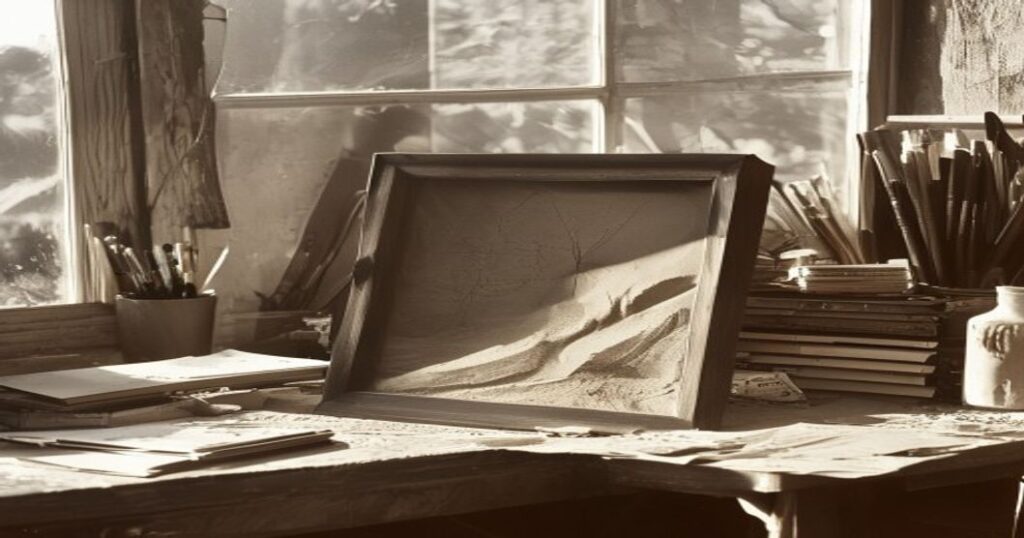
Every object in your home has a backstory, but some are more interesting than others. The moving sand picture — that thin glass frame where colored sand falls through liquid and builds slow miniature mountain ranges — has a surprisingly specific one.
It was invented by one man, in a workshop, as a side experiment in a larger art practice. It spread almost entirely by word of mouth. It was licensed widely, imitated poorly, and occasionally made beautifully. And today, four decades on, it sits in an unusual middle space — somewhere between kinetic sculpture, craft object, and household decor.
This is the short version of that history, as someone who makes these now can tell it.
The Original: Klaus Bosch, Oregon, 1980s
Klaus Bosch was a German-American artist and educator who, in the late 1970s and early 1980s, was teaching and making kinetic art in Oregon. Kinetic art — art that involves motion — was already a recognized 20th-century form by then: Alexander Calder’s mobiles, Jean Tinguely’s self-destructing machines, Bruno Munari’s “useless machines.” Bosch was working in that lineage, interested specifically in slow motion, in objects that changed on a human rather than a mechanical scale.
The story, as Bosch and people around him told it, is that the moving sand picture grew out of experiments with sand in closed containers. He was playing with the way granular materials behaved — the avalanches, the self-organization, the quasi-liquid flow — and at some point realized that if you slowed it down enough, by suspending the grains in a viscous liquid between two panes of glass, the behavior became a visible phenomenon, slow enough for a human viewer to actually watch.
The first moving sand pictures — Bosch called them “sandscapes” or “sand art pictures,” depending on the piece — were made by hand, in relatively small editions. They were artist objects, not commodities. They were signed. They sold through galleries, craft fairs, and through direct relationships with collectors.
What made Bosch’s originals different from the mass-produced versions that came later was the specificity of the design. The glass was thin enough to read as a picture-frame rather than a toy. The sand colors were chosen with genuine compositional intent — often pairs or triads that created a landscape rather than a random scatter. The liquid medium was tuned so the grain-flow was slow but not sluggish. And the air bubble, which is the element that makes the whole piece work (it’s what causes the grains to cascade as it rises), was sized so the pattern formation was rich rather than simple.
The result was a new aesthetic category — something between a painting, a sculpture, and a scientific demonstration. And because each flip produced a genuinely new image, it had an ongoing relationship with its owner that a static painting couldn’t.
The First Spread: The 1990s
Through the 1990s, Bosch’s sandscapes spread beyond the original collector circles in two directions.
First, they spread through the gift shop and museum store economy. Every art-adjacent museum started carrying small licensed or licensed-adjacent sandscapes in their shops. Kids encountered them on school trips. Adults encountered them at science museums (they’re beautifully demonstrative of granular-flow physics). The category’s name started to drift: some catalogs called them “sand art pictures,” others “sandscapes,” others “sand paintings” (a problematic name, because sand painting in cultural context refers to the completely different practice of Navajo sand painting and other ritual traditions).
Second, they spread through the New Age and wellness market. The meditative quality of watching sand fall got attention from the slow-living and mindfulness communities early. Sandscapes started appearing in therapy offices, Zen-inflected interior design magazines, and meditation-adjacent catalogs. This gave the category a second identity, separate from the kinetic-art tradition Bosch was working in.
By the late 1990s, sandscapes had split into three rough tiers of object:
- Art pieces: Bosch’s own work and close imitators making small editions by hand. Expensive, carefully made, sold through galleries.
- Designer pieces: higher-end manufactured versions, usually in Germany, Japan, or the U.S., that kept the aesthetic integrity of the originals but scaled production.
- Low-end mass-market: plastic-framed, low-quality-sand, sold in shopping-mall gadget stores. These are what most people saw first, and they produced a slight stigma around the category that persists to this day.
Why Most Sandscapes Are Bad
Here’s the thing worth naming directly. Most of the moving sand pictures in circulation today are not good.
The cheap mass-market versions cut every corner. The glass is too thick, so the visual depth is reduced. The sand is low-grade colored silica, sometimes just dyed plastic beads, which doesn’t flow naturally. The liquid is often a cheap mineral oil that clouds over a year or two. The air bubble is too big or too small. The colors are harsh — primary colors that evoke a children’s toy rather than a landscape. The frame is plastic.
A person who has only ever seen a $15 version has no idea what a well-made sandscape looks like. They think “moving sand picture” and they imagine a gas-station gift-shop object, and they can’t understand why anyone would pay $80 or $150 or more for one.
This is the curse of the category — the original was a genuine piece of kinetic art, but its mass-market descendants flattened the form so badly that it acquired a reputation as a kitsch object. Restoring the category to something closer to Bosch’s original intent has been the project of a handful of working artisans over the last fifteen years, my own small workshop among them.
The Design Problem
Making a sandscape that actually works — that holds the viewer’s attention, that forms patterns that look like real landscapes rather than scattered grains — turns out to be one of the most constrained design problems I know.
Every variable trades against every other variable. Thicker glass makes the piece structurally sound but kills the visual depth. Finer sand flows more smoothly but produces less-distinct patterns. More viscous liquid slows the flow (good) but makes the air bubble travel too fast (bad). Brighter sand colors make the picture pop but destroy the landscape illusion. A larger frame looks more impressive but makes the cascades spread too thin.
The thing people don’t realize, until they’ve actually tried to make one, is that every single parameter has to be right. Get any one wrong — sand size, liquid viscosity, bubble size, glass thickness, color selection, frame design — and the piece is bad in a way that’s hard to articulate but immediately obvious.
This is why, despite forty years of market existence, good sandscapes remain rare. You can’t reverse-engineer one from a photo. You have to iterate, physically, through dozens of prototypes.
The Cultural Position Today
Moving sand art is having a quiet second life in the 2020s.
Two things drove this. First, the mindfulness and slow-living movement, which gave a natural home to objects designed for soft fascination rather than utility. Second, the social-media-era interest in hypnotic visual objects — the same cultural moment that made kinetic sand videos, fluid simulations, and infinite-loop aesthetic accounts popular on Instagram and TikTok.
The sandscape — a genuinely physical, non-digital version of the “hypnotic visual” — slotted naturally into this moment. Clips of sandscapes doing their slow cascades went viral. Interior designers started specifying them as quiet focal point pieces. Office design specs started including one on reception desks. The product returned to something closer to its original purpose: a slow, beautiful object meant to be watched.
What’s different about this revival, compared to the gift-shop era, is the rise of small workshops making them well. A handful of makers — in the U.S., Germany, Japan, and now my own workshop — are producing small editions with the original Bosch-era design integrity. Better glass. Better sand. Better frames. Tuned compositions.
If you buy a sandscape today, you’re choosing between two worlds: the mass-market object at $20–40 that will frustrate you, and the artisan-made piece at $80–250 that will actually work.
Klaus Bosch’s Legacy
Bosch himself was never a household name. He was a working artist who happened to invent an object that spread through culture faster than his reputation did. The objects he made are now in hundreds of thousands of homes. His name, on most of them, is absent.
But the aesthetic principles of his original work — slow flow, self-organizing patterns, colors chosen like a landscape painter’s palette, the integration of scientific phenomenon with artistic presentation — are still the reference point for everything made in the category. Every good sandscape made today is, in some sense, an echo of his original experiment.
If you want to see his work directly, a handful of museums hold Bosch originals in their permanent collections, and his pieces occasionally show up at estate sales and auction. They are easy to tell apart from mass-market versions once you know what to look for: the thinness of the glass, the quality of the sand, the restraint of the color palette.
A Short Lineage, Object-by-Object
If you wanted to trace the full lineage of the moving sand picture, it would go roughly like this:
- Navajo and Tibetan sand painting: ancient traditions of creating colored-sand compositions, often ritual and temporary.
- Hourglasses (15th century on): one of the first Western objects to isolate granular flow as a visual experience.
- Kinetic art (1920s–60s): Alexander Calder, Jean Tinguely, Bruno Munari, Yaacov Agam, Takis — all exploring motion as an artistic medium.
- Klaus Bosch’s sandscape (1980s): the specific invention of a granular-flow object in a glass frame, designed for domestic viewing.
- The 1990s–2000s gift-shop era: mass-market versions that flattened the form.
- The 2020s slow-living revival: a return to higher-quality, artisan-made versions for a culture increasingly interested in non-digital, attention-restorative objects.
Each step in that lineage inherited something from the previous one. Moving sand art isn’t one of those products that appeared from nowhere — it’s an object with roots that run back hundreds of years, through several traditions, that happen to have met in one Oregon workshop in the 1980s.
Watching One Today
If you have a good moving sand picture, here’s what’s happening when you flip it.
You’re watching a miniature demonstration of the same granular physics that governs avalanches, dune formation, and landslide dynamics. You’re seeing the results of Klaus Bosch’s design decisions from forty years ago — the sand grain size he chose, the liquid viscosity he landed on, the color pairings he found worked. You’re participating in a slow-art tradition that goes back through kinetic sculpture to sand painting to the earliest time-keeping objects humans made.
And for the next twenty minutes or so, you’re being kept company by a small physical system that is doing something genuinely unpredictable, genuinely beautiful, and genuinely of its own time — which in a moment dominated by flattened digital visuals is no small thing.
Vee Sharma writes the Moving Sandscape blog. The studio’s work — most prominently the deep-sea sandscape — sits in the long lineage of sand art and kinetic sculpture, and most of the writing here is an attempt to do justice to that lineage. Read more about Vee →