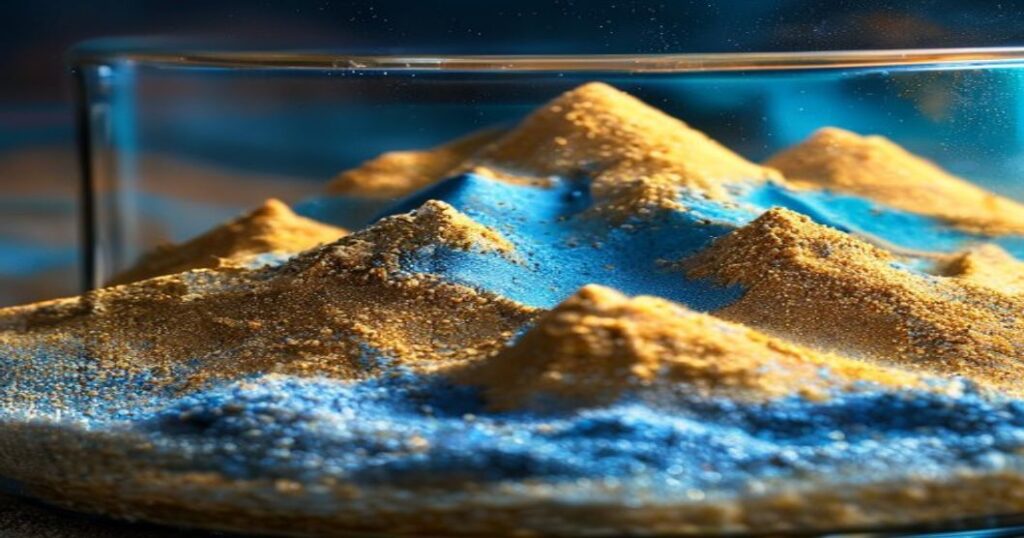
The first time I really looked at the sand settling in one of my own pictures, I realized something I hadn’t expected. The shapes being built weren’t random. They looked like mountains. Not metaphorically — they had the structure of actual mountain ranges. Peaks at particular angles, layered deposits at particular thicknesses, ridgelines that followed familiar contours.
That was strange. No one had designed these shapes. A machine hadn’t calculated them. Colored grains were falling through a liquid inside a sealed glass frame, and they were organizing themselves into landscape without any outside instruction.
This phenomenon — granular materials forming landscape-like patterns without direction — is one of the most beautiful and least understood corners of physics. It’s called self-organization, and it’s a genuine frontier of research. It’s also the key to understanding why moving sand art looks the way it does, and why real sand dunes look the way they do, and why beach cusps form with surprising regularity, and why a hundred other shapes in nature emerge from nothing but grains and gravity.
This is the physics of why mountains form, at every scale.
Start With a Single Idea: The Angle of Repose
The whole subject rests on one concept. If you understand it, most of what follows makes intuitive sense.
Pour dry sand onto a flat surface. It doesn’t pile up vertically. It spreads into a cone. If you keep pouring, the cone grows, but the angle of the cone’s sides stays fixed. For dry sand, that angle is around 33 degrees.
This is the angle of repose: the steepest slope that a granular material can hold without collapsing. Put the grains at a steeper angle and they slide; put them at a shallower angle and they sit still.
The angle of repose varies by material. Dry sand is around 33°. Gravel is steeper, around 40°. Snow is around 38°. Flour is shallower, around 25° (because flour particles stick to each other slightly, which changes the physics). But for any given material, the angle is remarkably consistent. It’s a function of grain shape, grain size, friction between grains, and the weight of each grain.
Here’s the important consequence: whenever you have a pile of granular material being added to from above, the pile will always tend back toward this angle. If you dump more sand on top, the slope steepens momentarily, then avalanches to restore the angle. The angle of repose is an attractor — a stable state the system keeps returning to, no matter what you do.
This is already a form of self-organization. The pile has no instructions, no plan, no designer. It just behaves this way because of the local physics of how grains interact with each other.
Avalanches and Intermittent Flow
The next key idea. When the pile gets steeper than the angle of repose, it doesn’t adjust smoothly. It adjusts through avalanches — sudden cascades that release just enough grain to return the slope to stability.
Watch a moving sand picture as you flip it and you’ll see this clearly. Sand accumulates against the trapped air bubble. The slope steepens. The slope steepens more. Then — suddenly, not gradually — a visible avalanche ripples down the face, carrying hundreds or thousands of grains, restoring the angle. Then accumulation resumes. Another avalanche. Another accumulation.
This intermittent rhythm — accumulation, collapse, accumulation, collapse — is the defining feature of granular self-organization. Physicists call it stick-slip behavior, and it’s the reason granular shapes have a certain visual character that liquid shapes don’t.
Water flowing down a hill produces smooth curves. Sand flowing down a hill produces layered terraces. Every avalanche leaves a distinct depositional line where it stopped. Over time, these layered traces build up into the structured ridgelines that make moving sand pictures look like actual landscapes.
The mountains are records of individual avalanches. That’s why they look the way they do.
Per Bak and Self-Organized Criticality
In 1987, physicist Per Bak, along with colleagues Chao Tang and Kurt Wiesenfeld, published a paper that changed how science thought about granular piles.
Bak’s central claim was this: a pile of sand, continuously fed grains from above, naturally settles into a critical state — a state poised exactly at the edge of stability, where any tiny addition could trigger an avalanche of any size, from a single grain to a full cascade. The pile isn’t stable, it’s barely not collapsing, perpetually. And the size distribution of the avalanches follows a beautiful mathematical rule: a power law. Most avalanches are tiny. A few are medium. Very few are enormous. And the same pattern repeats at every scale — if you look at a miniature corner of the pile, you find the same distribution as the whole pile.
This property — the system organizing itself into a critical state without outside control — is called self-organized criticality. And once Bak identified it in sand, researchers started finding the same signature everywhere.
Earthquakes follow it. The size distribution of earthquakes on any fault line is a power law, and the physical mechanism (stress accumulation, sudden release, repeat) is direct granular analog. Forest fire sizes. Extinction events in the fossil record. Neural avalanches in the brain. Stock market crashes. The frequency of words in a language. The sizes of cities in a region. All show the same mathematical signature.
Bak’s thesis was that a huge class of natural systems — ones composed of many interacting units each obeying simple rules — spontaneously evolve toward these critical states. The sandpile was just the cleanest possible model.
How This Produces Landscape Shapes
Here’s where it connects back to the mountains.
When sand settles in a moving sand picture, thousands of micro-avalanches are happening in rapid succession. Each one leaves its depositional signature. Over the course of a full settling cycle (a few minutes), the surface has been shaped by a torrent of small events, each obeying local physics, collectively producing a layered form.
The reason this looks like landscape is that real landscapes were formed by the same mechanism, just on geological timescales.
A real mountain range, over millions of years, is shaped by avalanches, landslides, deposition events, and erosion — all granular-flow processes, all obeying the same angle-of-repose physics, all layered upon each other. The mathematical signature of landscape is the signature of granular flow, writ large.
A moving sand picture is, in a specific technical sense, a miniature simulation of the same forces that shape real mountains. Run the clock faster (minutes instead of eons), use a denser fluid (glycerin instead of air and water), and scale down (centimeters instead of kilometers) — but the physics is the same. Which is why the shapes that emerge look, to our pattern-recognition systems, like recognizable landscape rather than random scatter.
Why the Patterns Are Different Every Time
One thing people always ask about moving sand pictures: how can it never make the same pattern twice? They’re just grains of sand in liquid.
The answer comes from a property of self-organized critical systems called sensitivity to initial conditions.
When you flip the frame, the exact starting positions of the grains are microscopically different every time. The trapped air bubble forms in a slightly different place. The first few grains to fall start the first few avalanches in slightly different locations. Each avalanche influences the pile in ways that influence the next avalanche, and so on. These small differences cascade upward through the settling process, and within a few minutes the differences are macroscopic.
In computer science this is sometimes called the butterfly effect. In dynamical-systems language, it’s called chaos. In the specific language of granular physics, it’s called intrinsic stochasticity of avalanche dynamics.
The practical consequence for anyone who owns a moving sand picture: the number of distinguishable patterns the system can produce is effectively infinite. Not metaphorically. Actually — the number of distinguishable final states far exceeds the number of times the picture could physically be flipped over its lifetime. If you flipped yours 100,000 times, every single flip would produce a genuinely novel composition.
This is one of the reasons a moving sand picture remains interesting over years of ownership in a way that a static object can’t — you are literally watching a system that cannot repeat itself.
Beach Cusps, Dunes, and Other Self-Organizing Sand Landscapes
The same physics that creates the shapes inside a moving sand picture creates, at larger scales, some of the most striking self-organized structures in nature.
Beach cusps. On sandy beaches, you’ll often see regularly spaced scalloped shapes along the shoreline — peaks of sand alternating with shallow bays, evenly spaced at 10 to 30 meters. No one designed these. They emerge from the interaction of wave action, grain transport, and the local angle-of-repose of wet sand. The regularity is a signature of self-organization: a simple iterative process converging on a stable spacing.
Sand dunes. Dunes take many shapes — barchans (crescent), transverse (ripples perpendicular to wind), longitudinal (ridges parallel to wind), star dunes (radiating arms). Each shape is a stable solution for a particular combination of wind direction, wind variability, and sand supply. No human plans them. They’re the natural self-organized forms sand takes under those conditions.
Ripples. The tiny regular ripples you see on a dry sand beach or desert surface — these are self-organized too, emerging from the feedback between wind transport and surface shape. They have a characteristic wavelength determined by grain size and wind speed.
Aeolian bedforms on Mars. Mars’s surface is covered with ripples and dunes that look eerily similar to Earth’s, despite a completely different atmosphere. The same self-organization mechanism produces the same forms. The physics doesn’t care where the sand is — it applies universally.
All of these shapes emerge, without design, from simple local rules. That’s what self-organization means.
What It Means to Watch One
If you watch a moving sand picture for long enough, you start seeing patterns that the physics predicts and explains.
The long diagonal ridges forming along the air bubble’s rising path — those are the edges of individual avalanches frozen in place. The darker bands where one color concentrates more than another — those are the result of size-sorting during flow, because smaller grains slip through gaps in the larger ones at slightly different rates. The occasional dramatic collapse, where a whole shoulder of sand lets go at once — that’s a large-scale avalanche, the equivalent in your picture of a real-world landslide.
You’re watching a very condensed, very visible demonstration of some of the most beautiful physics in nature. And knowing what the processes are doesn’t diminish the effect — if anything, it deepens it. The shapes you’re looking at are the same shapes that carve canyons, build dunes, and structure mountain ranges, just compressed into a shelf-sized frame.
A Short Summary of the Ideas
- Sand settles at a consistent angle (angle of repose), around 33° for dry sand.
- When a pile exceeds this angle, it adjusts through sudden avalanches, not gradual slides.
- Bak’s self-organized criticality: a sandpile perpetually lives at the edge of stability, with avalanches of all sizes following a power-law distribution.
- These same dynamics produce shapes — mountains, dunes, beach cusps, ripples — at every scale.
- A moving sand picture is a small, visible demonstration of these same physics at domestic scale.
- The patterns are genuinely non-repeating because the system is sensitive to microscopic initial conditions.
Why All This Matters Beyond the Physics
There’s one more idea I want to end on.
For most of human intellectual history, we assumed that ordered shapes required a designer. Mountains, spirals, dunes, ripples, crystals — surely someone or something had to plan them. One of the most profound shifts of modern physics is the recognition that order can emerge from disorder without design. Simple local rules, repeated across many interacting units, can produce complex, beautiful, specific structures.
Sand is the cleanest possible example. No biology. No design. Just grains and gravity. And out of that come mountains.
Knowing this changes how you see landscape. It changes how you see nature. It gives you a deeper appreciation for the specific, strange beauty of shapes that arise rather than being made. And if you happen to own a moving sand picture — it turns the shelf into a very small window onto one of the deepest and most elegant principles in physics.
About the author: Vee Sharma writes the Moving Sandscape blog and designs the studio’s kinetic sand art pieces, including the deep-sea sandscape. More about Vee →