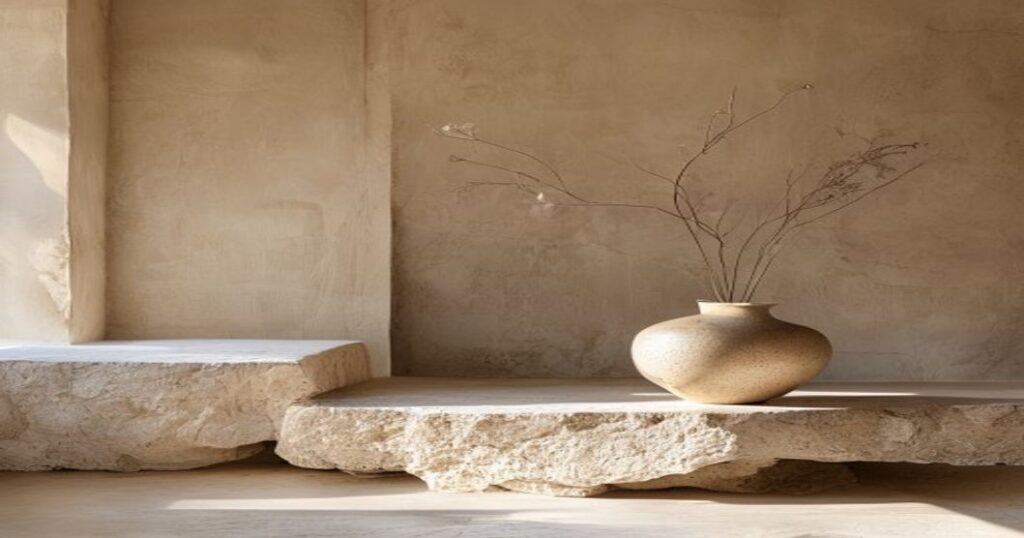
There’s a version of “statement piece” that ruins rooms.
The neon sign over the bar. The oversized typography print that reads “GATHER” in thirty-point sans-serif. The hot-pink velvet sofa that owns the living room before anyone walks in. These pieces demand attention. They shout. They’re statements in the same way that someone interrupting a conversation is a statement — they take space by force, not by quality.
And then there’s the other kind — the statement piece that stops you when you enter a room but takes a beat to notice. You feel its presence before you locate it. Often it’s smaller than you’d expect. Often it’s in a neutral palette. Often it’s sitting slightly off-center, or mounted at an unusual height, or made of a material that’s pulled from nature instead of a factory.
Those are the statement pieces that actually work. The ones that anchor a room without conquering it.
I’ve been thinking about this category for years. Every designer whose work I genuinely admire — Axel Vervoordt, Rose Uniacke, Ilse Crawford, Vincent Van Duysen — operates almost exclusively in this mode. Not loud statements. Quiet anchors. And the effect they produce — rooms that feel considered rather than decorated — is what most people actually want when they say they want a beautiful home.
Here’s what makes a quiet statement piece work, and twelve specific ideas you can actually use.
The Physics of a Quiet Statement Piece
Before the list, the underlying mechanics. A quiet statement piece has three properties. Miss any of them and the piece slides into “loud” territory.
Scale contrast with its surroundings. A quiet piece is usually larger than everything around it, but not bigger than the room itself needs. A 70cm tall ceramic vessel on a console table that otherwise holds small objects becomes a focal point through scale alone — no color, no pattern, no novelty required. The contrast with the small objects makes it register.
Material weight. Quiet pieces are typically made of old or natural materials — stone, aged wood, unglazed clay, patinated bronze, hand-woven fiber, weathered metal. These materials have what interior designers sometimes call gravity — they feel like they belong to a longer time than their surroundings. That weight is what produces the anchoring effect.
Restrained color. A quiet statement piece lives almost entirely within the palette of the room. Stone, cream, charcoal, earth. The piece doesn’t introduce a new color conversation — it deepens the existing one. When you break this rule with a specific, careful color choice, the effect can be extraordinary. But the rule is: subtle first.
If your candidate piece fails on any of these three, it’s a loud statement piece in quiet clothing. It’ll read as “decor” rather than as a true focal point.
12 Pieces That Actually Work
1. An oversized ceramic vessel
The most reliable quiet statement piece in the world.
Find an unglazed or matte-finished clay vessel — anywhere from 40 to 90cm tall — and place it alone, on the floor, slightly off from a wall corner. Not on a table. On the floor. Not with a plant in it (that’s a different, busier choice). Empty, or with a single large branch if you must.
Sources: any working potter’s Instagram, Tappan Collective, or look for vintage olive-oil jars from Mediterranean estate sales. Old is better than new.
2. A single large framed textile
Instead of a painting, a framed textile — a handwoven piece from a traditional weaver, an old saree hung flat, a large piece of vintage mud cloth, or a kilim fragment. Mounted cleanly on a wall, framed in a thin oak or metal edge.
The texture of textile against a painted wall produces a calmer focal point than any canvas would. It reads as culture rather than as decoration.
3. A low wide table instead of a coffee table
Most coffee tables are low-wide versions of existing furniture types. The quieter version: a single slab of reclaimed wood, maybe 30cm high, much wider than you’d expect. Or a single large stone on a minimal base. Something that reads more like low plinth than table.
A coffee table like this becomes the statement piece by quiet mass. Everything you put on it — a book, a cup — reads more significant because of the surface it sits on.
4. A single piece of modern sculpture
Here’s where most rooms miss. People fill shelves with small decorative objects when they could place one real piece of sculpture — a single carved wooden form, a small bronze, a found-object assemblage — and let it do all the work.
A sculpture for a quiet statement piece should be slightly abstract, smaller than you think (30–60cm), and placed with real negative space around it. No competing tchotchkes within two feet.
5. A moving sand picture, larger than you’d expect
I’ll name my own product here because the effect is particularly strong at larger sizes.
A standard small moving sand picture is a lovely desk object. But at A3 or larger, placed alone on a console or mounted on a wall as the single piece of art, it crosses into quiet-statement-piece territory. The moving element is what makes it work — the slow, living change keeps the eye returning without demanding attention. It’s almost impossible to build a focal point that’s both restful and genuinely interesting. Moving sand art does that by virtue of being both static as an object and dynamic as an image.
6. A floor-to-ceiling linen curtain
Not a window treatment. A curtain used architecturally — dividing a space, softening a wall, draping across a doorway as a textural wall in its own right.
Heavy natural linen, hung from a thin brass or oak rod, pooling slightly on the floor. Used this way, a curtain becomes a quiet statement about the whole room. It says: soft spaces, natural materials, slow time.
7. A single great chair
A very good chair placed alone — not part of a conversation group — is a statement. A vintage Hans Wegner. A Pierre Jeanneret. A well-made contemporary piece from Carl Hansen or Frama. Placed in a corner, by a window, at an angle that isn’t strictly functional, it becomes a punctuation mark in the room.
The implication: this chair is for reading, for thinking, for being. The room instantly reads as a place with interior life.
8. A monolithic mirror
Not an ornate framed mirror. A simple, large, unframed rectangle — mounted flush against a wall or, more interestingly, leaned against the wall like a piece of art.
At 180cm+, leaned against a living room or bedroom wall, a simple mirror reflects light, extends the room, and reads as a piece of sculpture in its own right. Sources: Hay, Ferm Living, or vintage full-length mirrors with minimal frames.
9. A single, oversized branch in a heavy vessel
Literally a tree branch. One. 2–3 meters tall. Placed in a heavy ceramic or stone vessel in a corner.
This is so simple it feels like nothing. In practice, an oversized bare or leafy branch is one of the most potent natural statement pieces you can make. It draws the eye up, introduces organic line, and brings weather — the outside — into the room. Renewed every season.
10. A hand-woven basket the size of a piece of furniture
Most baskets are small. The quiet-statement version is about 80cm tall, open-top, placed on the floor. Used for throws, or wood for a fireplace, or as pure sculpture.
Look for traditional makers: Rwandan imigongo, Ghanaian Bolga baskets in oversize, African Zulu beer baskets scaled up. The visual effect of a single massive woven form in a room of flat surfaces is dramatic and quiet simultaneously.
11. A stack of books — specifically, thirty very good books on one stack
Not on a shelf. On the floor. In a single tall stack, maybe 80cm high, next to a chair or a low sofa.
The books become the sculpture. The specificity of the stack — these books, chosen, held together by their weight — tells you more about the owner of the room than almost any other object could. And visually, a stack of 30 beautiful hardcovers is a quiet monolith, full of texture (spines, titles, colors) but simple in silhouette.
12. A functional piece, elevated: a kitchen bowl on an empty dining table
Sometimes the best quiet statement is a single working object, scaled up.
A beautiful wide ceramic mixing bowl on a bare dining table. A large wooden bread board leaning against the kitchen wall. A single enormous raw-linen tablecloth folded in a low ceramic tray. These are the kinds of pieces that quietly announce this is a house that cooks and eats.
Placement: remove everything else from the surface. Let the one functional object do the work alone.
Common Mistakes
If your quiet statement piece isn’t working, it’s almost certainly one of these.
Too many at once. A room has one primary focal point. Maybe two, max, in different zones. If you have three “statement pieces” in a single space, they’re competing, and the room reads busy.
Fighting the background. A quiet statement piece needs space around it. If the piece is sitting against a wall with three framed prints, or on a table with six decorative objects, it can’t perform its anchoring function. Remove, subtract, create breathing room.
Symmetry anxiety. People put their statement piece dead-center. That kills it. Quiet statement pieces nearly always work better slightly asymmetrically placed — off-axis, off-center, slightly unexpected.
Matching to the rest. The statement piece doesn’t need to “match” — it needs to anchor. A rough, raw ceramic next to polished wood works because of the contrast, not despite it. If your statement piece shares material and finish with everything else in the room, it vanishes.
Too new. The singular most common mistake. A quiet statement piece needs age or naturalness in its materials. Brand-new, factory-finished objects rarely produce the effect. Look for hand-made, vintage, natural-material pieces.
How to Find Them
The best quiet statement pieces don’t live on Amazon.
Estate sales. A surprising number of great vintage vessels, textiles, and mirrors live in the homes of people who have passed on. Estate sales are underused sources — and they’re usually priced close to nothing.
Small potters and weavers on Instagram. The best ceramic vessel I own came from an Instagram potter I found through a friend. $280, which felt steep, and which I would happily pay three times for now.
Antique shops with terrible websites. The store worth visiting is the one whose Instagram is barely maintained and whose inventory is on cards taped to the furniture.
Trade shows for interior designers (if you can get in). The shows where real pieces come from aren’t retail-facing. ICFF in New York, Maison & Objet in Paris. If you can attend as a designer’s guest, even looking is a free education.
Architectural salvage yards. Underrated. Sections of old stone, sculptural metal elements, huge architectural fragments — priced fairly if you’re willing to collect.
What Quiet Statement Pieces Do For You
Beyond the aesthetic: a room anchored by a quiet statement piece feels more settled to live in.
Your eye has a place to land. Your sense of the room’s center is clear. Small shifts in other objects don’t destabilize the composition, because the anchor is doing the structural work. Over time, you stop fiddling with the room — you just live in it. The room has a spine.
This is the under-discussed reason that designers obsess over finding the right statement piece. It isn’t about photographing beautifully. It’s about how the room feels after a week, after a month, after a year. The quiet statement pieces keep performing silently long after the loud ones have exhausted themselves.
So if you’re rethinking a room this year — don’t start by shopping for small objects. Start by finding the one big thing. The vessel. The chair. The branch. The sand picture. Find the anchor first. Everything else falls into place around it.
Vee Sharma is a designer and the founder of Moving Sandscape. The studio produces a small range of handcrafted kinetic sand pictures, including the deep-sea sandscape, and Vee writes the editorial essays here. About Vee →