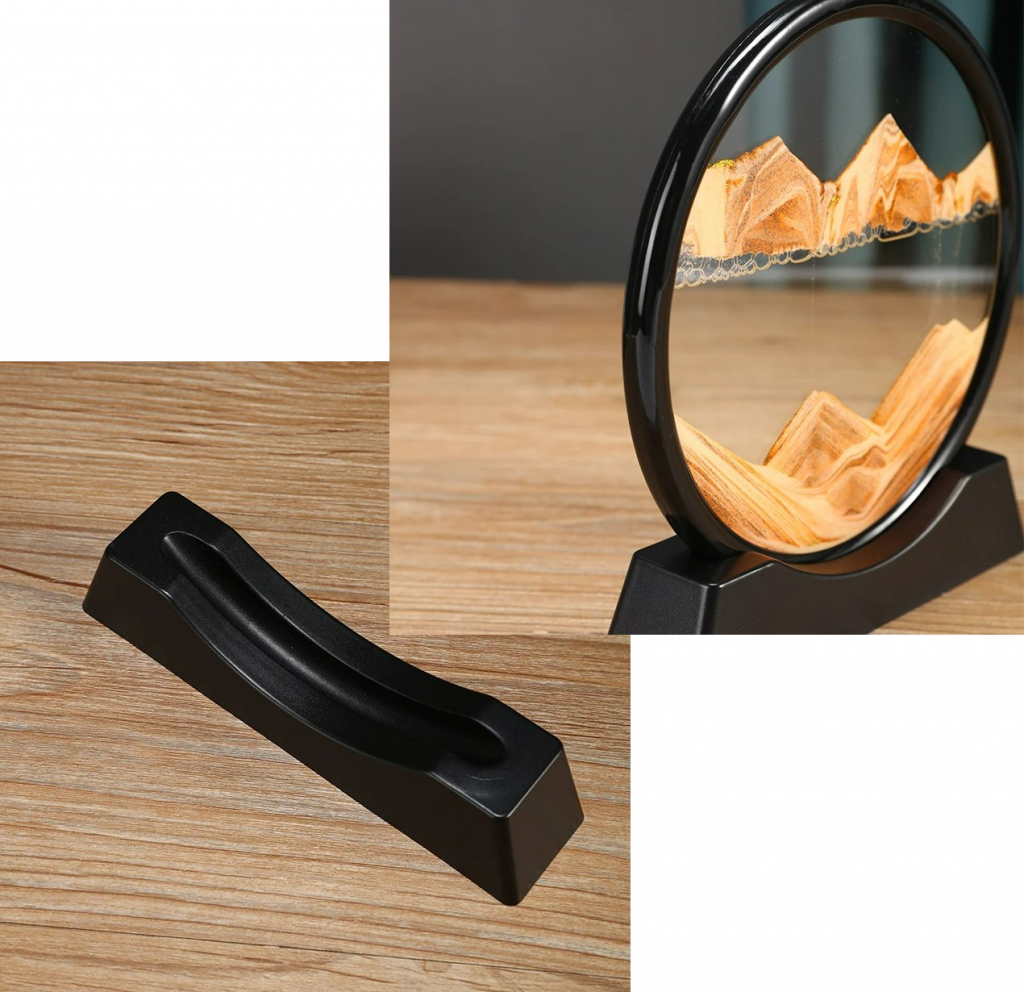
Remote work was supposed to free us from the soul-sucking monotony of cubicle life. Instead, for many of us, it replaced one kind of monotony with another. The same chair. The same desk. The same four walls. The same Slack notifications. The same slow cognitive grind of back-to-back video calls. And somewhere along the way, our home offices — the places we spend most of our waking hours — started feeling less like sanctuaries and more like productivity factories with better snacks.
That is why the object you choose to sit on your desk matters more than you might think. A plant. A framed photo. A fidget toy. An hourglass. The small things you look at between tasks shape the texture of your workday. And of all the desk companions a remote worker could pick, one keeps showing up in the home offices of designers, writers, engineers, therapists, and founders: the moving sand art picture.
This article is about why that is. Why a simple piece of glass filled with sand and liquid has become one of the most quietly beloved objects in the remote work toolkit, and why it might be exactly what your desk needs.
The Remote Worker’s Core Problem: Cognitive Loops With No Exit
Office work was never perfect, but it had one hidden benefit that remote workers lost almost overnight: natural cognitive breaks. Walking to a meeting room. Refilling your coffee in a shared kitchen. Bumping into a colleague at the printer. These small, unscripted interruptions gave your brain a chance to breathe between tasks.
At home, those interruptions vanished. You roll out of bed, walk ten steps to your desk, and you are already working. Your computer is the meeting room, the kitchen, the printer, the social lunch, and the commute home. Everything happens inside one rectangle of pixels. Your eyes do not rest. Your brain does not switch contexts. Your stress accumulates in a background hum that you stop even noticing until 3 PM when you suddenly cannot think straight.
Neuroscientists call this the “attention residue” problem. When you jump from meeting to email to coding to calendar to Slack without any real break, the previous task keeps running in the background of your mind, stealing cognitive resources from whatever you are currently trying to do. The only fix is a real break — even a brief one — where your eyes and brain rest on something that is not a screen.
This is the gap a moving sand art picture fills. It gives your eyes somewhere soft to land. It gives your hand something to do that is not typing. It gives your brain a small sensory reset without requiring you to stand up, walk away, or break your workflow entirely.
What Happens When You Flip Your Sand Art During a Workday
Let us walk through what actually happens neurologically when you pause mid-task, reach for your moving sand art picture, flip it, and watch the sand cascade for a minute before returning to work.
First, the motor act of reaching and flipping engages your proprioceptive system — your sense of body in space. This is the same system that relaxes when you fold laundry, knead dough, or shuffle cards. It is a quietly grounding input your brain does not get from typing.
Second, your eyes shift focal depth. You are no longer staring at pixels six inches in front of your face. You are looking at a physical object, following the cascade of sand particles moving at different speeds through liquid. This depth change alone relaxes the ciliary muscles in your eyes, the muscles that accommodate focus and are chronically strained by screen work.
Third, your attention narrows onto a single slow process. This is called “single-task attentional focus” and it is the opposite of the hypervigilant, task-switching mode you have been in for the last three hours. Just thirty to sixty seconds of this focused watching triggers a small parasympathetic nervous system response — your heart rate slows slightly, your breathing deepens, your shoulders drop a fraction of an inch.
Fourth, and this is the underrated part, the sand finishes falling. The motion ends. You return to work. But your brain has just been given a complete, miniature arc — beginning, middle, end — that provides a subtle sense of resolution. That closure resets your attention more effectively than checking your phone or scrolling Twitter, which have no resolution and tend to hijack your focus rather than restore it.
All of this happens in about two minutes. That is the magic.
Why Sand Art Beats the Other Usual Suspects
Remote workers have tried many desk objects for this kind of sensory break. Most of them have specific problems that moving sand art does not have.
Fidget Toys
Fidget spinners, fidget cubes, and other small mechanical toys engage your hands but not your eyes. You usually end up fidgeting while still staring at the screen, which defeats much of the purpose. They also tend to feel childish in a serious work environment, which makes adults self-conscious about using them during calls.
Desk Plants
Plants are wonderful. They do have a real mood-lifting effect. But they do not actually do anything moment-to-moment. You cannot interact with them during a stressful meeting. They do not give you a sensory break on demand. They are beautiful background, not responsive companion.
Smartphone
This is the one most remote workers default to, and it is by far the worst. Picking up your phone for a “break” is like leaving one screen for a smaller screen that is specifically engineered to hijack your attention. You think you are taking a break, but you are deepening the same attentional depletion you were trying to escape.
Coffee or Snack Runs
These work, but they interrupt deep work entirely and add calories you may not need. They also put you at the mercy of whoever else is in the kitchen. They cannot be done quickly in the middle of a call.
Hourglasses and Sand Timers
These are the closest competitors to moving sand art and they share many of the same benefits. The downside is that hourglasses are linear and predictable; you know exactly how the sand will fall because it falls the same way every time. Moving sand art is different every flip. That unpredictability is what keeps it visually engaging over months and years.
Moving Sand Art: The Sweet Spot
A moving sand art picture does what all of these objects do partially, all at once. It is visual. It is tactile. It is unpredictable. It is ritualized. It does not ping you. It does not require you to leave your desk. And it can be used during calls — with the camera pointed at your face, you can silently flip your sand art and watch it mid-meeting without anyone knowing you just took a micro-break.
The Video Call Problem and the Sand Art Solution
Let us talk about video calls specifically, because they are the single most draining part of remote work.
Back-to-back video calls create a specific kind of exhaustion — “Zoom fatigue” — that researchers have been studying since 2020. The causes include prolonged eye contact, seeing your own face on screen, cognitive overload from interpreting partial nonverbal cues, and the forced stillness of sitting rigidly in front of a camera for hours.
Moving sand art gives you a discreet counterweight to all of this. During calls where you are listening more than speaking, you can keep the sand art just off-camera or in your peripheral vision. Your eyes can briefly drift to it. You can flip it during a transition. You can rest your gaze on the slow-falling sand between your own speaking turns. It gives your overworked social-cognition circuits a place to breathe.
The one caveat: do not flip it when you are actively presenting or being intently watched. It will distract both you and anyone who can see the motion in the background. Keep it for the listening phases.
How a Moving Sand Art Picture Changes Your Workday Rhythm
Many remote workers report that adding a moving sand art picture to their desk subtly changes the shape of their day. Here is what that shift tends to look like.
In the first week, you mostly just notice that you have something new on your desk and flip it occasionally out of novelty. The behavior is still conscious and deliberate.
By the second week, flipping starts happening automatically at natural breakpoints — right after sending an email, right after closing a doc, right before joining a meeting. The brain has learned that these transitions are good moments to reset, and the sand art becomes the anchor for that reset.
By the third or fourth week, the flip has become a quiet signature of your workflow. You barely think about it. But you notice that your afternoons feel less foggy, your shoulders feel less locked up, and you stop feeling the urge to grab your phone between tasks. The sand art has replaced what used to be a phone-check reflex with something calmer and more restorative.
This is not a placebo. It is a classic habit formation curve. Anchoring a short sensory break to a physical object makes the break happen automatically rather than requiring willpower every time.
Positioning It On Your Desk
Where you place the sand art matters as much as owning one. Here are the positioning principles that seem to work best.
Within Arm’s Reach
If you cannot easily flip it without stretching or standing up, you will not flip it as often. Put it somewhere your dominant hand can reach in a single natural motion.
Just Off-Screen-Center
Ideal placement is just outside your main visual focus — typically to the side of your monitor, about eight to twelve inches from your keyboard. Close enough to see in your peripheral vision, far enough not to compete with your screen.
Not Directly Behind You on Camera
Be aware that if your webcam captures the area behind you, sand art in the frame can sometimes be visually distracting to meeting participants. Either place it off-camera, or in a spot where the motion will not be visible during calls.
Well-Lit But Not Glare-Prone
The piece should be lit well enough that you can see the patterns clearly, but not so close to a window that reflections turn the glass into a mirror. A desk lamp angled toward the piece at low intensity often works beautifully.
Matching the Sand Art to Your Work Type
Different kinds of remote work benefit from different kinds of sand art. A few rough matches.
Deep Focus Work (Writing, Coding, Design)
Calming blue-and-white palettes work best. You want the breaks to be genuinely restorative rather than stimulating. Slower, more layered pieces give you deeper resets between long sessions of concentration. A Movingsandscape deep sea sandscape picture is a popular pick for this work style because the oceanic imagery reinforces the focus-to-calm transition.
High-Social Work (Therapy, Coaching, Sales, Customer Success)
Warm earth-tone palettes tend to suit this work. You are dealing with emotions and relationships all day; a warm, grounding piece provides a gentle nervous system anchor between difficult conversations. The piece should feel like a trusted friend at the edge of your desk.
High-Volume Context Switching (Product Managers, Executives, Consultants)
Higher-contrast pieces — black sand in clear liquid, or bold multi-color blends — are more easily read in a glance. When your day is a blur of ten-minute context switches, you want a sand art piece you can parse instantly even when tired.
Creative and Brainstorming Work (Writers, Artists, Strategists)
Multi-color and more organic pieces can be ideal. They introduce more visual variety and unpredictability, which actually supports divergent thinking. Staring at the sand mid-brainstorm often surfaces ideas you did not know you had.
The Underrated Social Benefit of Sand Art on Video
There is an interesting social dimension to sand art that rarely gets mentioned. Colleagues notice.
When you have a moving sand art picture on your desk, it reliably becomes a conversation starter in meetings. “What is that on your desk?” “Can you flip it?” “Oh wow, that is hypnotic.” In a work environment dominated by antiseptic video backgrounds and generic home office setups, a piece of actual moving art gives people something human to talk about before the meeting starts.
This is a small thing. But for remote workers who sometimes feel disconnected from their colleagues, those small conversational hooks matter. The sand art becomes a quiet signal of personality, patience, and attention to small pleasures — qualities that are sometimes hard to convey over Zoom.
When Sand Art Is Not the Right Desk Companion
Let us be fair. Moving sand art is not right for every remote worker.
If your work involves constant high-stakes typing — transcription, data entry, customer support chat — you may not have space on your desk or in your attention for a visual companion. The sand art needs a moment of rest to be used well.
If you have ADHD and find moving objects deeply distracting rather than calming, some people find sand art more problematic than helpful. If that is you, keep it within reach but out of your direct peripheral vision, so you can choose when to engage rather than constantly being pulled toward the motion.
If your desk is already heavily loaded with monitors, plants, keyboards, and other gear, adding a sand art piece may just be clutter. Consider whether you have a genuinely usable flat surface where the piece can live without being shoved aside. If not, a smaller desktop size or even a wall-mounted piece behind your desk may be a better fit.
FAQ: Moving Sand Art for Remote Workers
How often should I flip my sand art during a workday?
There is no rule. Most people flip it somewhere between five and fifteen times across a workday, usually at natural transitions between tasks. Think of it less as a prescribed ritual and more as a small reset available any time you need one.
Will it actually distract me from work?
In the first few days, maybe a little — it is new and your attention will drift toward it. After a week or two, it fades into the background and only pulls your attention when you consciously reach for it.
Can I use it during video calls without being rude?
Yes, as long as you are not the one speaking and the motion is not prominently in your webcam frame. During listening phases of a call, a gentle flip is usually invisible to other participants.
What size is best for a home office desk?
Desktop sizes between five and eight inches are usually ideal. They sit comfortably beside a monitor without taking over the desk and are light enough to flip casually.
Does it really reduce stress or is it a placebo?
It is a mix of real effects and anchoring psychology. Watching slow cascading motion genuinely activates a parasympathetic relaxation response. But the bigger effect is behavioral: the object gives you a reliable cue to take brief sensory breaks you would not otherwise take, and those breaks add up over a day.
Is it too expensive to justify for a single desk object?
For what you use it for — multiple small mental resets per day, for years — most people find it well worth the one-time cost. Think of it less as decor and more as a productivity tool with aesthetic benefits.
What if I share my desk with a partner who also works from home?
Most shared-desk remote workers end up sharing their sand art too, and report that it becomes a small ritual object in the relationship. Two people flipping the same piece between their own work sessions is a quietly connecting thing.
The Desk Object That Earns Its Space
Most desk accessories are forgettable. Within a month, you barely notice they are there. A moving sand art picture is different precisely because it is never the same twice. Every flip is a small new landscape. Every cascade is slightly different. That is why, a year later, you are still reaching for it with the same quiet satisfaction as the first week.
Remote work asks a lot of your attention, your eyes, and your nervous system. You deserve a desk companion that gives something back. Sand art is one of the few objects that does, in a way that is neither gimmicky nor showy. It just sits there, ready for the next flip, offering you a two-minute break from the screen any time you need one. For a remote worker, that is not decoration. That is infrastructure.