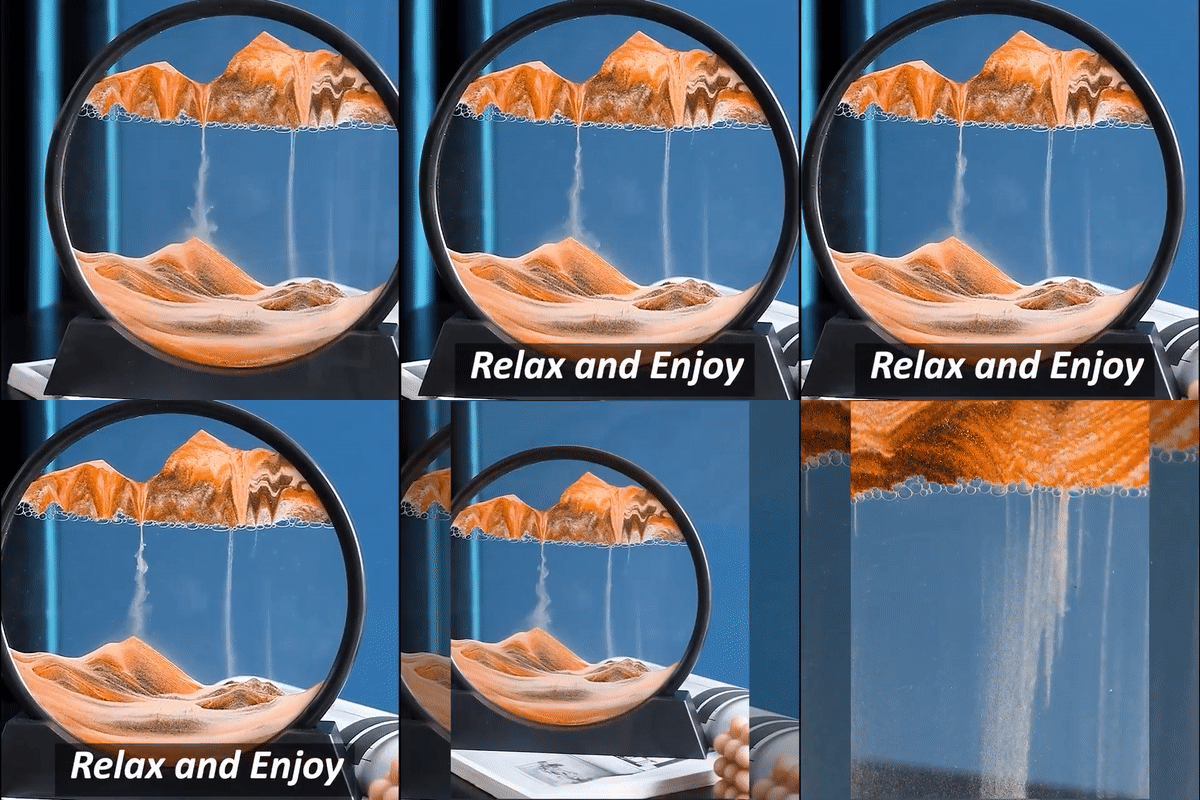
It is nearly midnight. You have tried three browser tabs of lo-fi, a candle that keeps guttering out, and a breathing app you already resent. You just want something to look at. Something that moves without demanding anything. Something that makes the room feel alive but does not start a conversation.
This is where the three giants of “object decor that does the emotional work for you” line up: the lava lamp, the bubble column, and the moving sand art picture. All three sell themselves on the same promise – visual calm you do not have to work for – but they deliver on that promise in very different ways. This article is a head-to-head comparison, based on how each one actually behaves in a real room, on a real desk, in a real life.
If you only have sixty seconds: lava lamps win on nostalgia and ambient color, bubble columns win on size and spectacle, and moving sand art wins on quiet, adult-looking calm. If you want to live with one of these for years, not just unbox it for a TikTok, stay with me.
The Three Contenders in Plain English
Before we compare, let us be precise about what each object actually is. A lot of the internet confuses “lava lamp” with “bubble lamp” and “sand lamp” with “sand art,” so the comparison often ends up unfair.
The lava lamp
A lava lamp is a sealed glass vessel holding a translucent fluid and a waxy blob. A bulb at the base gently heats the wax. Warm wax rises, cools near the top, falls back down, and repeats. The movement is slow, organic, and unpredictable. The light comes from the same bulb, so the whole object glows. It runs on electricity and needs time – usually 30 to 60 minutes – to warm up before the “lava” starts flowing. Classic sizes range from 8 inches tall (desk) to 27 inches (floor). Invented in 1963, it is the elder statesman of calming decor.
The bubble column / bubble tube
A bubble column is a tall, clear, water-filled acrylic tube with an air pump at the base. The pump pushes a steady stream of bubbles up through the water. LEDs at the base cycle color, lighting the whole column. Some include floating plastic fish or similar trinkets that ride the bubble currents. Bubble columns are often sold as “sensory tubes” and are a staple in sensory rooms, autism therapy spaces, and children’s bedrooms. They are loud in two ways: they bubble audibly, and the hum of the air pump runs the entire time.
The moving sand art picture
Moving sand art – sometimes called a sandscape, sand painting, or kinetic sand art – is a sealed glass frame containing two liquids of slightly different densities, colored sand grains, and a small amount of trapped air. When you flip the frame, the sand slowly filters from top to bottom through the air bubble. Each flip produces a different landscape: dunes, mountains, islands, waterfalls. It does not plug in. There is no sound. There is no light source. It moves only when you flip it. Most designs are 8 to 16 inches wide, mounted on a small wooden or metal stand.
So already you can see these are not really the same category. One uses heat, one uses air, one uses gravity and buoyancy. One is always on, one is always on, one is never on unless you activate it. Let us score them.
Head-to-Head: Ten Categories
1. Quality of movement
This is the whole point, so let us start here.
The lava lamp’s movement is slow and organic. Blobs form, stretch, break, and merge. It looks vaguely biological, which is why some people find it hypnotic and others find it vaguely unsettling. The movement is random but the rhythm is predictable – once it is warm, it blobs on and on at roughly the same tempo.
The bubble column’s movement is fast, repetitive, and loud. Bubbles shoot up in a constant stream. It is lively, even chaotic. It reads as “energy” more than “calm.” For small children and people with sensory seeking profiles, that energy is the appeal. For an adult trying to wind down at 10 p.m., it can feel like being in a low-rent aquarium.
Moving sand art has the slowest, most varied movement of the three. The initial fall is fast – dramatic, almost – and then it settles into a multi-minute slow cascade as a final plume of sand trickles across a newly formed landscape. Unlike the other two, it has a beginning, middle, and end. It finishes. Then it waits, frozen as a picture, until you flip it again.
Winner for pure calm: moving sand art. The variation plus the finite arc lets your brain actually settle. Winner for continuous ambience: lava lamp.
2. Hypnotic pull (the “stolen minutes” test)
All three are designed to pull your eyes. The question is how much attention do they extract from you – and on your terms, or theirs?
A lava lamp in your peripheral vision barely moves; you can ignore it for long stretches. A bubble column is loud enough visually and aurally that it stays in your foreground. Moving sand art only asks for attention right after a flip; once the landscape is set, it becomes wallpaper.
This matters. A desk object that pulls your attention constantly is not a focus tool – it is a distraction with better branding. A desk object that pulls attention only when you ask it to is a focus tool. Moving sand art and the lava lamp both score well here. The bubble column, honestly, loses this round for anyone trying to work.
3. Noise
Lava lamps are silent except for the occasional faint click of the bulb. Moving sand art is completely silent. Bubble columns hum – the air pump running 24/7 produces a low but persistent white-noise-plus-tinkling-bubbles sound that some people like and some people cannot tolerate.
Winner: moving sand art and lava lamp, tied at zero decibels.
4. Heat and power
Lava lamps draw 25 to 40 watts and run hot – the glass globe is genuinely warm to the touch after an hour. They should never be left on overnight, never moved while warm (the wax clouds), and need at least four hours of rest between runs. This is rarely advertised clearly.
Bubble columns pull less wattage (usually 10 to 20 watts for the air pump and LEDs) but typically run continuously. Over a year, they use more electricity than a lava lamp that is switched on for a few hours a day.
Moving sand art uses zero electricity. You flip it and gravity does the work. For a desk object you want to look at every day for years, that difference compounds – not a lot on your bill, but a lot in decision fatigue.
Winner: moving sand art.
5. Lifespan and maintenance
Lava lamps have a clearly-known failure mode: the wax eventually clouds, the fluid discolors, or the bulb dies. Replacement bulbs are specific (usually R39 or R50 types) and can be hard to source. Most lava lamps give ten good years of use before cloudiness sets in; some much less if they are overused.
Bubble columns age less gracefully. The pump is the weak point – after a few thousand hours, it starts to rattle or fail outright. The water in the tube grows algae if not changed and treated with chlorine tablets or the supplier’s additive. LEDs last a long time but the pump is the bottleneck.
Moving sand art has almost no maintenance. The liquid and sand are sealed; there is no bulb, no pump, no filter. The only real risks are physical damage (drop = cracked glass) and, rarely, air-bubble shrinkage over many years, which slightly slows the flow but does not ruin the piece. Well-made sandscapes are routinely going 15 years strong.
Winner: moving sand art.
6. Safety (kids, pets, bedrooms)
Lava lamps get hot. They should never be placed on something flammable, never within reach of young children, and never left on when you leave the room. There have been rare but documented cases of lava lamps overheating when put on stovetops by users who thought they could “speed up” warm-up time.
Bubble columns are genuinely child-safe at the surface level – many are designed for children with sensory needs – but they plug into the wall, and the cord plus water combination deserves respect. Tipping is a real concern for the taller ones.
Moving sand art is the safest of the three. No heat, no electricity, nothing to knock into water. Glass can break if dropped, but the liquids used in reputable sandscapes are non-toxic. For nurseries, bedrooms, and houses with curious toddlers, moving sand art wins clearly.
Winner: moving sand art.
7. Aesthetic fit
This is a matter of taste, but there are patterns.
Lava lamps have a strong visual identity – sixties, psychedelic, dorm-room. In a minimalist or Japandi interior, a lava lamp screams. It works beautifully in a maximalist, retro, or deliberately nostalgic room, and looks badly out of place almost anywhere else.
Bubble columns read as “sensory room” or “kid’s room.” They do not have a neutral aesthetic. The plastic construction, the floating-fish variants, and the color-cycling LEDs are all clearly in the “fun” visual register. In an adult living room, a bubble column reads as out of place unless the rest of the room leans playful or aquarium-y.
Moving sand art sits in a different register entirely. Framed like a small painting, the glass-and-wood construction feels gallery-adjacent, not gadget-adjacent. It fits minimalist, Scandinavian, Japandi, coastal, and earthy styles without conflict, and it sits comfortably on a desk, a console table, or a bookshelf without announcing itself as a “thing.”
Winner: it depends on the room, but moving sand art is the most style-flexible.
8. Price
Small, authentic lava lamps start around $25 and climb to $100 for larger, better-made ones. There are many cheap knockoffs that fail inside a year.
Bubble columns range from $40 for a 20-inch desk model to $300+ for a 5-foot sensory-room tower. The bigger the column, the more the pump struggles over time, so the price-to-lifespan ratio is not linear.
Moving sand art picture pricing runs from around $40 for small designs to $150 for wide, heavily-pigmented sandscapes with premium frames. Because they require no maintenance, the ten-year cost of ownership is lower than lava lamps and far lower than bubble columns.
Winner on upfront price: all three are similar. Winner on cost per year of use: moving sand art.
9. Interactivity
A lava lamp is a switch-it-on-then-ignore object. It has no interactive input beyond the on/off switch.
A bubble column has very limited interactivity – usually a button to cycle LED colors, sometimes a remote. The bubbling itself is not something you control.
Moving sand art is the only object of the three that rewards being touched. You pick it up, flip it, and the result is always new. This creates a meaningful ritual. It is the difference between watching an aquarium and skipping a stone – one is passive, one is a tiny act. For people who want a physical, hand-engaged break from screens, this matters enormously.
Winner: moving sand art.
10. Portability
Lava lamps are fragile when warm and bulky when cold. You do not carry a lava lamp from the bedroom to the desk.
Bubble columns are impossible to move once filled with water. They live where you first set them up.
Moving sand art is small enough to relocate in seconds. Desk in the morning, living room shelf in the evening, bedside table at night – all easy.
Winner: moving sand art.
When to Actually Pick a Lava Lamp
A lava lamp is the right choice when you want ambient glow first, movement second, and you are building a room whose aesthetic actively welcomes retro color. A bedroom in a deliberately seventies style, a home studio for making music, a basement lounge with neon and vinyl – these are rooms where a lava lamp earns its place. It is also genuinely one of the best low-light bedside companions if you find total darkness agitating. Pick one if you want something that is always quietly on, always glowing, and that you do not need to interact with at all.
When to Actually Pick a Bubble Column
A bubble column is the right choice for sensory-focused rooms, children’s spaces, playrooms, and therapy or classroom settings. For a child with autism, ADHD, or sensory processing needs who finds steady bubbling visually regulating, a bubble column is a serious tool, not a gimmick. It is also a reasonable choice for larger spaces where you want a vertical statement piece with color-changing ambience and you do not mind the hum. Pick one if the people using the room are under twelve or have a specific sensory need the bubble motion is meeting.
When to Actually Pick Moving Sand Art
Moving sand art is the right choice for the largest group of buyers: adults who want something visually calming on a desk, shelf, or table, that looks like art instead of a toy, does not need to be plugged in, and can be enjoyed in a moment rather than as constant background noise. It is the best of the three for offices, bedrooms, meditation spaces, reading nooks, and nurseries. It is the best gift of the three because it works in almost any room and any aesthetic. And it is the best long-term purchase because nothing breaks, nothing wears out, and nothing costs you electricity to enjoy.
This is exactly why we built our deep sea sandscape picture – a version designed for adults who want daily calm without the cord, the heat, or the hum.
Can You Combine Them?
Yes, and some rooms benefit from it. A common winning combination is a lava lamp for ambient background glow in a den plus a moving sand art picture on the desk you actually work at. The lamp handles mood lighting; the sand art handles active focus breaks. These two do not compete – they do different jobs.
Bubble columns are harder to combine because they tend to dominate the space they are in. If you have a bubble column, it will probably be the visual anchor of that room and you will want the other decor to step back.
The Most Common Complaints About Each
For lava lamps: “mine stopped flowing,” “the wax clouded after a year,” “it got too hot to leave on,” “I can smell it when it is running.” The first three are real and mostly solved by buying a well-reviewed brand and respecting the rest cycles. The smell issue is a sign of a cheap unit; better lamps are odorless.
For bubble columns: “the pump is so loud,” “the water got cloudy,” “my floating fish got stuck,” “the cord is annoying.” These are all well-known and mostly unsolvable; they are structural features of the design, not defects.
For moving sand art: “the sand is stuck” (you likely received one where the air bubble has settled in a corner – flip a few times to reset), “the flow is too slow” (usually means a high-density premium design; this is actually the selling point), “it stopped at an odd angle” (flip it again; the next landscape will be different). Real defects exist but are rare compared to the other two.
FAQ
Which one is quietest?
Moving sand art and a lava lamp are both effectively silent. A bubble column hums continuously.
Which one is safest around pets?
Moving sand art, by a wide margin. There is no cord for a cat to chew, no heat for a dog to bump into, and nothing to tip into a pool of water.
Which one works in a minimalist space?
Moving sand art. Lava lamps read retro; bubble columns read childlike. A framed sandscape reads like small-scale gallery art and sits calmly in minimalist, Japandi, or Scandinavian rooms.
Which lasts the longest?
Moving sand art. With no bulb, pump, or fluid to degrade through active use, a good sandscape can still be flowing beautifully fifteen or twenty years in. Lava lamps usually cloud or fail in 5 to 10 years. Bubble column pumps are the shortest-lived component of the three.
Which is best for kids?
Bubble columns for children under about eight, especially those with sensory needs. Moving sand art for children over eight who can be trusted to handle glass. Lava lamps are not a great choice for children’s rooms because of the heat.
Which works on a desk during work hours?
Moving sand art wins this one cleanly. It does not demand constant attention, it does not hum into your microphone on video calls, and the flip-and-watch ritual is a legitimate focus reset between tasks.
Are any of these actually scientifically calming?
Slow, biological motion in peripheral vision reduces stress arousal in small studies, and this principle applies to all three. But attention load matters: calming movement that is hard to ignore ends up net-negative for focus. That is the case against bubble columns in work settings and the case for moving sand art.
Can I take any of these on a plane?
Moving sand art can be checked in a padded case; the sealed liquid designs are not flammable. Lava lamps contain flammable wax and are generally refused as carry-on. Bubble columns are too large and water-filled to travel with.
The Final Verdict
On pure nostalgia and warm ambient glow, the lava lamp still holds its throne after six decades. On spectacle and sensory regulation for kids, the bubble column is the clear pick. But for the quiet, adult, all-rooms, all-years, zero-maintenance calm that most people actually want from a desk decor object, moving sand art beats both of them across nine of our ten categories.
It is silent. It is cordless. It is finite. It is handheld. It is framed like art. It is safer. It lasts longer. It fits more rooms. And its small ritual – flip, watch, return to work – is the one feature neither of the other two can ever replicate, because neither of them asks to be touched.
If you are shopping for yourself, start with a single moving sand art picture. Live with it for a month. Then decide whether you want a lava lamp for the shelf above or a bubble column for somewhere else entirely. You might find, as most of our customers do, that you did not need the other two at all.