Occasionally, a moving sand art picture stops behaving like itself. The sand does not flow as smoothly as it did a year ago. A single patch hangs in the middle of the frame and refuses to fall. A small bubble has appeared at the edge that was not there when you bought it. Or — the most alarming version — the whole thing seems to have gone quiet: you flip it, and the landscape forms slowly, unenthusiastically, without the cascade you remembered.
None of this is unusual, and none of it means the piece is ruined. Kinetic sand art is a mechanical system; everything that affects the flow has a cause, and most causes have a simple fix that you can do in your kitchen with no tools. This guide walks through what is happening when each of these problems shows up, and the specific corrections that resolve them.
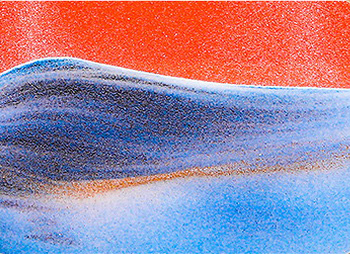
The physics behind the flow, briefly
A moving sand picture works because sand, being denser than the surrounding liquid, falls through it when the frame is inverted. The sand grains are sized and graded so that they fall at a specific rate; the liquid is thick enough to slow them, thin enough to let them move; and a single small bubble trapped inside the cavity acts as an essential valve — it gives the sand somewhere to escape to as the landscape builds, and without it, the piece would simply pack solid.
This matters for troubleshooting because most flow issues trace back to one of four things: the piece has been stored or held in an unusual orientation; the temperature is too low; the sand has packed or the bubble has travelled in a way that disrupts the usual path; or a mechanical issue (rare) has introduced a new variable.
Problem 1: the sand is stuck in one area and will not fall
This is the most common support question we get, and it is almost always fixable in under five minutes.
First, check temperature. If the piece has been sitting in a cold room (below about 18 degrees Celsius) or directly in front of an air-conditioning vent, the liquid has thickened slightly and the sand is moving through it more slowly. Bring the piece into a room-temperature space — a normally heated living room or kitchen — and let it sit flat for about twenty minutes. Then flip it and observe. In our experience, this resolves roughly half of stuck-sand reports.
If temperature is not the issue, the next step is what we call the “coax flip.” Lay the piece flat on a table, glass-side up. Gently, with both hands on the frame, tilt it slowly from one side to the other, about fifteen degrees of tilt in each direction, allowing the sand pocket to migrate. Do this three or four times. Return the piece to vertical and flip. Often the coax flip unlocks the stuck area by giving the sand somewhere else to go and letting the bubble reposition.
If the piece is still stuck, turn it on its side and leave it flat for twenty minutes. This lets the bubble travel back to a natural position. Then tilt upright and flip again. This is the heaviest reset, and it almost always works.
Never tap on the glass. Tapping a kinetic sand frame is the sand art equivalent of banging a broken appliance — it does not help, and it risks stressing the seam.
Problem 2: the sand flows, but too slowly
When a piece has been sitting untouched for several months, the liquid can develop a gentle settled state and the sand can compact slightly. The first flip after a long pause is often sluggish. This is normal.
The fix is simple: flip the piece twice in a row, giving each inversion enough time to produce its landscape. By the third or fourth flip, the system has re-equilibrated and the flow returns to its normal rate. If the piece remains slow after five or six complete flip cycles and the room is at a normal temperature, the underlying cause is almost always a very small change in bubble size, which is addressed below.
Problem 3: a new bubble has appeared
Every moving sand art picture ships with one small bubble inside the cavity, usually about the size of a five-pence coin or a US nickel. Over time, that bubble can look a little larger, especially after the piece has been stored flat or shipped internationally. An increase in bubble size of up to about twenty percent is normal and is caused by very slow, very small movement of dissolved gas in the liquid. It is not a leak.
A sudden large increase — for example, a bubble that was a coin-sized disk yesterday and is now a two-inch stripe — is a different category and usually indicates a seal issue. If this happens, lay the piece flat on a soft surface, photograph it against a plain background, and email the photograph to the maker. Do not continue to flip the piece; additional movement can accelerate the problem. In our case, a sudden bubble change within the warranty window is almost always diagnosed from a single photo and handled with a repair or replacement.
Problem 4: the sand falls but leaves unattractive lines or streaks
Occasionally the sand creates horizontal lines across a newly formed landscape that do not look like the smooth gradient you are used to. The most common cause is a small amount of sand that has adhered to the glass on the inside surface. A single firm flip followed by ten minutes of flat rest usually dislodges any residual grains.
If the streaking persists and is concentrated in one horizontal band, the piece has likely been stored on its side for a long period and the bubble has migrated to an unusual position. A full reset — flat for half an hour, tilt slowly to upright, flip — generally fixes it.
Problem 5: the piece has been flipped at the wrong orientation
Every moving sand art picture has a top and a bottom, and flipping from “top to bottom” produces one landscape; flipping from side to side produces a different one. Some people, when they first receive a piece, experiment with side flips and end up with a landscape that looks wrong — too flat, too one-sided, without the cascade they expected.
The fix is to reorient: set the piece down the “right way up,” let it settle for a minute, and flip top-over-bottom as intended. Every piece we make is designed for top-bottom inversion; the sand gradient and bubble position are engineered around that axis.
Problem 6: the liquid looks cloudy
If the liquid itself appears cloudier than you remember, rather than clearer, the usual cause is that the piece has been exposed to direct sunlight over a long period. UV exposure can slightly affect the optical clarity of the liquid over years. In this case, moving the piece to a less sunlit position and giving it a few weeks does not restore clarity, but it prevents further change.
If the cloudiness appeared suddenly (over days rather than months) and is accompanied by any new bubble, contact the maker. These two symptoms together sometimes indicate a specific issue that is addressed under warranty.
What not to do
A short list. Do not shake the piece vigorously; it will not unstick the sand and may stress the seal. Do not heat the piece with a hairdryer; the liquid cavity is not designed for thermal intervention and you can damage the glass or the seal. Do not store the piece on its side for more than a few days; the bubble migrates and the next few flips will be disappointing. Do not take the piece apart under any circumstances; the liquid-filled cavity is sealed for a reason and you will void the warranty on every maker’s product the moment you open it.
When to escalate to the maker
Email the maker with a photograph if any of the following occur: a sudden large change in bubble size over hours or days; a new dark line along the edge of the frame; liquid visible outside the cavity (even a tiny droplet on the frame); cloudiness that appeared suddenly; or a stuck-sand issue that did not resolve after all the above steps. For pieces bought from us, a short email to our support line with a clear photo and a description of when the issue started is enough. We respond same-day during the working week and can usually diagnose the problem from the image alone.
A longevity note
Well-made moving sand art lasts a long time. We have customers with pieces that are nearly a decade old and still flow as smoothly as the day they arrived. The most important operational habit is simple: flip the piece regularly (at least once a week), keep it out of direct sunlight, keep the room at a normal temperature, and do not store it on its side. A piece that lives a normal life in a normal home will behave well for years. When it occasionally behaves strangely, the fix is almost always patient, analog, and takes about twenty minutes on a Saturday afternoon.