If you are shopping for moving kinetic art and you have encountered the terms “liquid-filled” and “dry kinetic art,” you have run into two quite different categories that look similar in a listing photograph but behave very differently in a room. The decision between them matters more than most buyers realise. This guide explains what each one is, how they differ in flow, longevity, and installation, and which one fits which kind of room.
Both are legitimate categories, and neither is strictly better than the other. Getting the right one for the right space is the whole question.
What liquid-filled kinetic art actually is
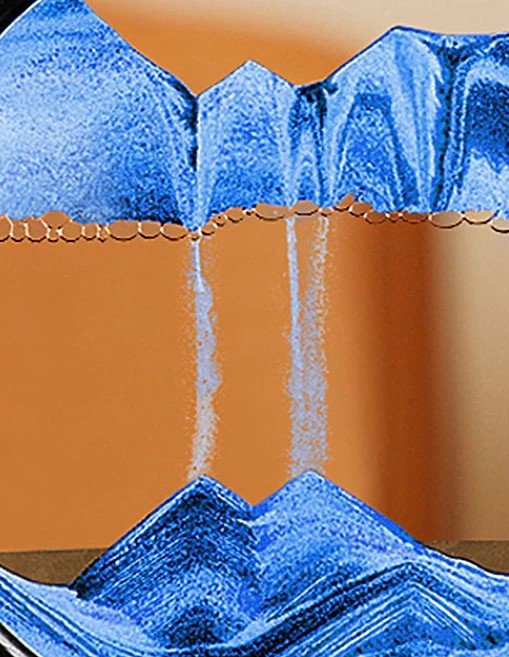
A liquid-filled piece — the category our own pieces belong to — has the sand suspended in a transparent liquid within a sealed cavity between two sheets of glass. The liquid is typically a glycerin-and-water blend with stabilisers and sometimes a faint tint. When the piece is inverted, gravity pulls the denser sand through the liquid; because the liquid resists the sand’s descent, the fall is slow, with visible turbulence and layered gradient formation. A single small bubble inside the cavity acts as an essential safety valve, giving the sand somewhere to displace to as the landscape forms.
The defining characteristic of a liquid-filled piece is the quality of the fall. The sand does not simply drop — it swirls, lingers, and settles into cascading patterns that can take three to ten minutes to fully form, depending on the piece’s size and palette. The resulting landscapes are more mountainous, more varied, and more reminiscent of natural erosion patterns than anything you can achieve with dry media.
What dry kinetic art actually is
A dry kinetic piece has no liquid. The sand sits in an air-filled cavity between two sheets of glass or acrylic, and when the piece is turned, the sand falls through air rather than liquid. The fall is faster — seconds rather than minutes — and the resulting landscape is usually simpler, with cleaner lines and sharper contrasts.
Within the dry category there are several subtypes. Classic sand pictures (sometimes called Ando pictures, after the original Swiss maker of the format) use graded sand in multiple colours that settles in layered compositions. Sand hourglasses use a single timed flow of fine sand through a narrow aperture for a timed visual interval. Sand-on-spindle pieces, a newer category, use a rotating surface inside a dry cavity to create slowly changing patterns.
The defining characteristic of a dry kinetic piece is crispness. The lines are sharper, the contrast between colours is more defined, and the landscape settles quickly — usually within a minute of being inverted.
How the two compare, head to head
Flow time. Liquid-filled pieces flow for 3 to 10 minutes per inversion, occasionally longer for large formats. Dry pieces typically complete their flow in 30 seconds to 2 minutes.
Landscape formation. Liquid-filled pieces produce elaborate, multi-peak, continuous landscapes with visible gradient zones and cascade patterns. Dry pieces produce cleaner, more geometric, more distinct layered patterns with harder edges between colours.
Meditation value. The longer flow time and visible turbulence of liquid-filled pieces make them the better choice for watching as a meditative or focus object. Dry pieces are more sculptural than meditative; you turn them and then live with the resulting landscape rather than watching it form.
Longevity. Well-made dry pieces can last decades with essentially no change because there is no liquid to yellow, cloud, or evaporate. Well-made liquid-filled pieces last about a decade of normal use, with gradual, small changes in the liquid over long periods. For pieces intended to be heirloom objects, dry can be a better choice.
Fragility. Both are glass-faced and similarly vulnerable to impact. Liquid-filled pieces have the additional concern of seal integrity; a compromised seal is a visible leak. Dry pieces have no liquid to leak; a damaged seal in a dry piece simply admits dust or changes pressure, both of which are less visually obvious.
Temperature sensitivity. Liquid-filled pieces have a safe operating range of roughly 5 to 35 degrees Celsius. Outside that range, the liquid behaves differently and the seal can be stressed. Dry pieces are essentially temperature-indifferent within any normal interior range.
Shipping. Liquid-filled pieces need more careful packing, particularly for international transit. Dry pieces are somewhat more forgiving but still vulnerable to impact.
Weight. Liquid-filled pieces are heavier than dry pieces at equivalent sizes. A medium liquid-filled piece at 50 x 35 cm weighs around 3 to 4 kg. A similar-sized dry piece weighs closer to 1.5 to 2.5 kg.
Price. At equivalent quality tiers, liquid-filled pieces are typically 20 to 40 percent more expensive than dry pieces, reflecting the more complex construction and the more elaborate sand blends.
Interactivity. Liquid-filled pieces reward being touched, tilted, and rotated slowly during the flow. Dry pieces are more “look but don’t touch” — once the flow has completed, additional handling is unnecessary.
Which is the right choice for a given room?
A few patterns emerge from customer conversations over the years.
Home offices and spaces where you will sit with the piece regularly. Liquid-filled, almost always. The longer flow time and meditative quality is what makes the piece valuable in a working environment. A dry piece is a decor object; a liquid-filled piece is a small, working appliance for attention.
Above-mantelpiece or statement-wall display in a living room. Either works. If the room is primarily for family gatherings and entertaining, dry is often the better choice because the piece is a picture that people look at occasionally rather than an activity. If the living room has a meditation or reading corner, liquid-filled is worth the premium.
Bedroom. Liquid-filled is the more popular choice, partly because bedroom kinetic art is often used as a wind-down object before sleep. The longer flow time is useful for that purpose.
Children’s rooms. Dry pieces, generally. They are lighter, tougher, and have no liquid to leak. They also form their landscape quickly, which suits children’s attention spans.
Waiting rooms, reception areas, and commercial spaces. Liquid-filled is usually the better choice. The continuous, slow flow gives visitors something to look at over an extended time; dry pieces settle too quickly to serve the “something to watch” function in a waiting context.
Bathrooms and humid rooms. Dry pieces with metal frames are the safest option. Liquid-filled pieces are not damaged by humidity but the wood frames on many of them respond to high humidity over years.
A note on hybrid pieces
A small number of makers produce hybrid pieces that combine a liquid-filled main compartment with a small dry sand timer mechanism. These are interesting as concept pieces but tend to be more mechanically complex and harder to repair. Unless the hybrid format specifically appeals to you, the split between pure liquid-filled and pure dry categories is cleaner.
Honest self-disclosure
We make liquid-filled pieces. Most of this guide’s detail about the liquid-filled category comes from direct experience producing the product. Our understanding of the dry category is as buyers and observers rather than as makers, and some of our generalisations about dry pieces may be coloured by that. If you are seriously considering a dry piece, we encourage you to also read reviews and guides from makers who specialise in that category.
That said, the two categories do genuinely appeal to different kinds of buyers. Our own customer base skews toward people who want to live with the piece actively — people who flip it daily, watch it for a few minutes, use it as part of a wind-down or a focus ritual. For that buyer, liquid-filled is the answer. For a buyer who wants a beautiful, sculptural landscape that lives on the wall and changes occasionally, a dry piece from a specialist maker is often the better investment.
A simple decision framework
Answer these three questions. Do you want to watch the piece for more than two or three minutes at a time? If yes, liquid-filled. Is the piece going into a room with regular humidity swings (bathroom, unheated conservatory)? If yes, dry. Is it going to be handled by children or in a space where a leak would cause real inconvenience? If yes, dry.
If you answered “no” to all three, the decision is more about aesthetic preference than performance, and either category will serve you well. If you would like a specific recommendation for your room, email us — we will tell you honestly if we think a dry piece from another maker fits your space better than our own product.