Japandi — the interior style that blends Japanese wabi-sabi with Scandinavian hygge — has become one of the most enduring design directions of the past decade. Both halves of the equation value warmth, simplicity, craft, and the quiet beauty of imperfect natural materials. Together they produce rooms that feel grounded, generous, and genuinely restful. The aesthetic is not trendy so much as it is slow-burn timeless: once a Japandi room is done well, it stays relevant across decades.
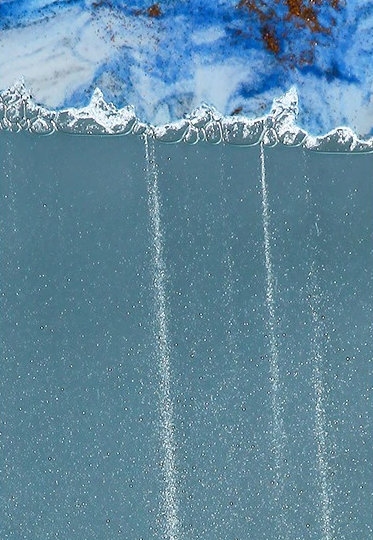
Moving sand art sits remarkably well in a Japandi interior. The natural materials, the slow motion, the minimal colour, and the echoes of Japanese sand garden tradition all speak the language of the style fluently. This guide is about doing the pairing well.
What Japandi is, briefly
A Japandi room combines two design traditions that are more alike than people realise:
- Scandinavian design contributes pale woods, clean lines, functional objects, and an emphasis on light. Furniture is spare but comfortable; colours are cool and restrained; clutter is edited out.
- Japanese design contributes low seating, restrained ornament, a love of natural materials (unfinished wood, clay, paper, linen), and the philosophical framing of wabi-sabi — the beauty found in imperfection, weathering, and asymmetry.
The overlap is the pleasure of less but better. A Japandi room is not cold and it is not austere; it is carefully edited and quietly warm.
Why kinetic sand art belongs here
Three reasons that connect to the aesthetic’s roots.
1. Echoes of the Japanese sand garden. The karesansui — Japan’s famous dry rock-and-sand gardens — is one of the oldest traditions of using raked sand to create landscape imagery as an aid to meditation. Modern moving sand art is a domestic-scale, enclosed relative of this tradition. Placing a sealed sand piece in a Japandi room introduces a small, contained version of the same contemplative object culture.
2. Slow, honest motion. Japandi objects are usually made to do one thing very well and to show exactly what they are made of. A moving sand art piece does exactly one thing — it creates slow landscapes — and shows you precisely how it does it. This kind of transparent function is a Japandi virtue.
3. Calm imagery. The mountains, dunes, and horizon lines that sand art produces are drawn from the same visual library as Japanese ink landscape painting (sumi-e) and Scandinavian coastal imagery. A kinetic piece adds an infinite-loop version of this imagery to a room.
Where to hang it in a Japandi room
Above a low console or tokonoma-style niche
Traditional Japanese rooms have a small recessed display area called a tokonoma, where a single scroll or flower arrangement was placed. Modern Japandi interiors recreate a version of this with a low console or a small wall niche devoted to one or two chosen objects. A round or rectangular sand frame above such a niche is a natural modern fit.
On a wall facing low seating
Japandi rooms often feature low seating — a floor cushion, a platform sofa, a low wooden bench. Hang the piece on the wall facing that seat, at the eye height of someone sitting low, which is around 110–120 cm from the floor. This is lower than conventional art-hanging advice and will feel correct inside the style.
In a hallway or transition space
Japandi design pays particular attention to transitions — entryways, hallways, the passage from one room to another. A compact sand frame on a transition wall, especially one with a small wooden bench and a ceramic pot beneath it, turns an overlooked corridor into a small contemplative moment.
Colour: restrained and natural
Japandi rooms use a narrow, warm-neutral palette: cream, bone, oat, pale oak, bamboo, charcoal, ink. Accent colours are few and usually drawn from nature — moss green, clay red, persimmon, deep indigo. Your sand piece should sit inside this palette, not outside it.
Good choices:
- Cream and charcoal — a near-monochrome piece that reads almost like ink on paper.
- Muted green and cream — reminiscent of both Japanese gardens and Nordic landscapes.
- Clay red and cream — a warm, very slightly persimmon-inflected choice that glows against pale wood.
- Ink blue and cream — deeply restful; reads as a kind of abstract Hokusai wave.
Avoid high-saturation palettes (bright red, electric blue, yellow). Japandi does not do volume.
Frame: pale wood, unfinished, or matte dark
Frame choice matters. A polished or heavily finished frame will feel wrong in a Japandi room. Reach for:
- Pale ash or light oak — unfinished or oiled rather than varnished.
- Raw bamboo-inspired frames — if available.
- Matte black steel — a minimal, architectural choice that works especially well in homes with dark window frames or charcoal details.
Avoid glossy walnut, shiny chrome, and brass frames — they speak mid-century rather than Japandi.
Pairing objects around the piece
Japandi interiors are about considered groupings. Around a sand piece, a typical composition might include:
- A single stem in a narrow ceramic vase — a dried grass, a single branch, one bloom in its season.
- A ceramic bowl on a wooden tray, ideally uneven and slightly weathered.
- A handmade paper lantern or a small unlined shade.
- A single book, laid flat rather than upright.
Do not over-fill. Two or three additional objects is plenty. Empty surface space is the point, not an accident.
Lighting: warm and uneven
Japandi lighting follows the Japanese preference for shadow as a design element, articulated in Tanizaki’s classic essay In Praise of Shadows. Bright, even, overhead lighting is the enemy. Instead, layer small warm sources: a paper lantern, a low table lamp, a single picture light on the sand piece itself. The room should have quiet bright spots and quiet dark spots, not uniform brightness.
Warm bulbs (2400K–2700K) are correct. Avoid cool white, which feels like an office.
The philosophical detail
Both Japanese and Scandinavian design traditions share a deep comfort with time. Wood is expected to patina. Linen is expected to crease. Ceramics are expected to craze over years. A good Japandi room is not trying to freeze in time; it is ageing on purpose.
A kinetic sand piece fits this mindset because it is, in a small way, time as a design element. Each flip takes its minutes. Each settling is different. The piece is never quite finished. If you come from a design culture that expects objects to be done and then simply sit there, this will feel unusual; within Japandi, it is exactly right.
A single room, finished
Imagine it: oak floorboards, a pale cream wall, a low platform bench upholstered in soft bone linen, a single hand-thrown ceramic bowl on a wooden tray beside the bench, a small paper lantern low on a floor stand, and on the wall a medium round kinetic piece in a pale oak frame with ink-blue and cream sand settling into slow horizons. It is nothing and it is everything. It is a room you could happily read in, think in, and grow old in. That is what Japandi is for, and a piece of slow kinetic art belongs squarely at its centre.