There’s a specific kind of tired that no amount of sleep fixes.
It isn’t physical exhaustion. It’s something quieter, sneakier. You’ve been on your laptop for six hours. You close it. You’re not sleepy exactly — but you can’t read. You can’t concentrate on a podcast. You can’t even really focus on a conversation. Your attention feels sanded down in some way that rest doesn’t obviously fix.
What you’re experiencing has a name. It’s called directed attention fatigue — the depletion of the specific cognitive muscle you use to focus on work, screens, and any task that demands sustained effort. And the fix for it, as described in one of the most elegant pieces of psychological research of the last fifty years, isn’t more rest. It’s a different kind of attention entirely.
This is the story of a concept called soft fascination, developed by the environmental psychologists Rachel and Stephen Kaplan in the 1980s. And it is, I would argue, one of the single most practical ideas you can know for navigating a screen-heavy, attention-fatigued modern life.
Two Kinds of Attention
To understand soft fascination, you first need to understand the distinction the Kaplans drew between two fundamentally different modes of paying attention.
Directed attention is the mode you use at work, on your phone, during a difficult conversation, while driving in heavy traffic, or writing a report. It’s effortful. It requires actively filtering out distractions. It’s controlled by a small region of your prefrontal cortex that’s doing metabolic work every second you sustain it.
And it fatigues. Measurably. The Kaplans drew on decades of earlier research by psychologist William James and others to argue that directed attention is a finite resource that gets depleted through use, and doesn’t just refill on its own. You can’t will it back. It has to be restored.
Involuntary attention is the mode that takes over when something interesting is happening nearby. You don’t decide to pay attention — your attention is just taken, automatically. A bird flies past the window. A leaf moves. A candle flickers. A dog walks down the street. The attention system engages, but it’s not the effortful version — it’s the automatic, no-cost version.
These two attention systems use different brain structures. Directed attention depletes; involuntary attention is more or less free. And — here’s the key insight — you can actually use involuntary attention to restore depleted directed attention.
That’s the whole trick.
Where Soft Fascination Comes In
Not all involuntary attention is the same, the Kaplans noticed. Some things grab your attention and then hold it intensely — a car crash, a loud argument, a video with rapid cuts. They called this hard fascination. Your attention is engaged, yes, but it’s not free to wander, reflect, or drift. Hard fascination pulls you in and keeps you captive.
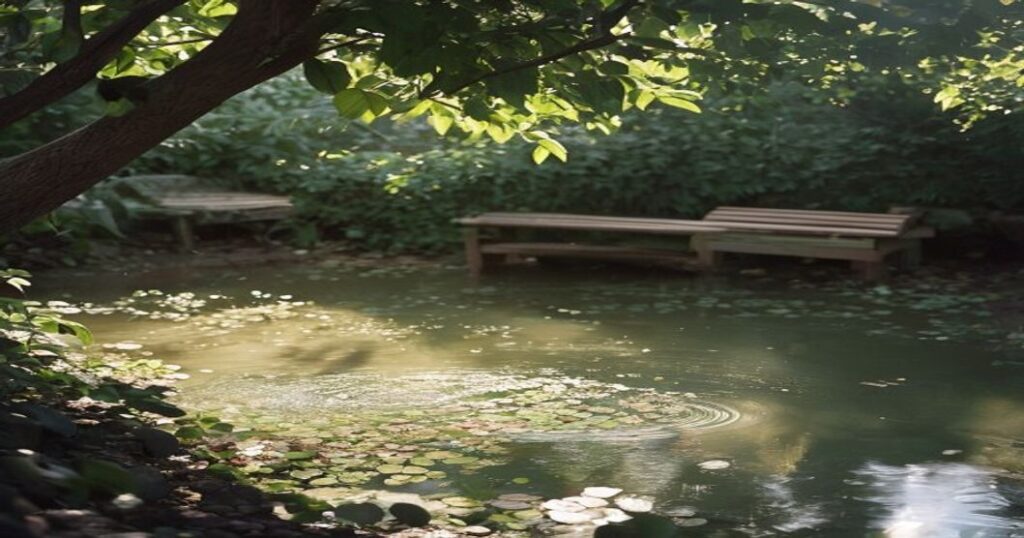
Soft fascination is the gentler cousin. It’s the mode of attention you use when you’re watching clouds drift, a fire burn, leaves move in wind, snow fall, sand run through an hourglass, water flow over stones, or a garden be visited by birds.
The Kaplans’ key observation: soft fascination is engaging enough to hold attention involuntarily, but gentle enough to leave room for the mind to wander, reflect, and — most importantly — restore depleted directed attention.
In other words, you sit with a soft-fascination stimulus, and while your attention system is idly engaged with it, your overworked prefrontal cortex gets a break. Real, measurable rest. And then, when you return to a demanding task, you have focus again.
This is the mechanism behind why a twenty-minute walk in a park — with no agenda, no phone, no podcast — resets you in a way that scrolling on your phone for the same duration doesn’t.
Why This Isn’t Mindfulness
Soft fascination is closely related to mindfulness but it isn’t the same thing.
Mindfulness is an active practice — you deliberately direct your attention at your breath, your body, your thoughts. It’s effortful in a way that still uses directed attention, even if it’s training a different version of it. Many people find it hard. Many drop it.
Soft fascination is passive. You don’t have to do anything. You just put yourself near the right kind of stimulus and your nervous system does the rest. The bar for entry is much lower. You don’t need to practice. You don’t need an app. You don’t need to close your eyes and watch your thoughts.
For this reason, a lot of people who have bounced off formal meditation find soft-fascination-based restoration accessible in a way mindfulness never was.
The Criteria for a Good Soft-Fascination Stimulus
The Kaplans identified several criteria that a stimulus needs to meet to produce the soft-fascination effect.
Gentle engagement. It has to hold your attention without demanding it. Fast cuts and loud sounds disqualify most modern media.
Enough novelty to track. A completely static stimulus fades into the background. A plain white wall doesn’t produce soft fascination; a quietly moving window does.
Low cognitive load. Nothing to solve, analyze, or respond to. The stimulus asks nothing of the viewer.
Room for wandering. The mind should be free to drift away and come back. Anything that demands continuous engagement fails this test.
A sense of being-away-ness. The stimulus should feel slightly separate from ordinary concerns — a different-enough visual or sensory field from the one you normally occupy.
These criteria disqualify most screen-based content. Podcasts partly work but the linguistic load is higher than ideal. Music mostly works if it’s instrumental. Television fails most criteria.
What does meet the criteria is remarkably consistent across cultures and eras:
- Natural water — creeks, oceans, fountains, rain
- Natural vegetation — trees, leaves, grasses in motion
- Fire — any flame, from a candle to a bonfire
- Clouds
- Sand and granular flow
- Animals at a distance — birds, fish in aquariums, grazing animals
- Weather — snow falling, mist
- Slow human activities at a distance — workers, walkers, markets
Almost all of these are things humans evolved around for hundreds of thousands of years. They are, in a real sense, the ancestral environment of the attention system.
Attention Restoration Theory, Summarized
The Kaplans’ full theory, which they published in a 1989 book called The Experience of Nature, has four elements — all of which they said a good restorative environment should have.
Being away. Physical or psychological distance from ordinary concerns. A park across town is good; a walk through your own neighborhood often isn’t quite enough because you see the same things you’d see from your house.
Extent. A sense of enough richness and coherence to feel like a whole environment, not just a small detail. A vast landscape, a long beach, a deep forest — all have extent.
Fascination. The soft-fascination element — stimuli that hold attention without demanding it.
Compatibility. A match between what you want and what the environment supports. A place that lets you just be, without requiring you to perform or achieve anything.
These four together produce the restorative effect. A park with good paths, some water, enough visual depth to feel “away” — full restorative environment. A busy waiting room with interesting paintings on the wall — fascination, maybe, but no extent, no compatibility, no being-away.
Bringing It Indoors
Here’s the practical question most people who encounter this theory have. Okay, so what do I do if I can’t go for a walk in a park right now?
Soft fascination does scale down. You can produce small, useful restorative effects indoors, at your desk, in fifteen minutes, with the right objects. The criteria are the same:
- Something gently moving
- Something with enough visual richness to track
- Something that demands nothing from you
- A quiet enough setting to let your mind wander while you watch
A fire in a fireplace is the single most effective indoor soft-fascination stimulus. Measurable reductions in stress, heart rate, blood pressure after fifteen minutes of watching a fire. Almost everything a walk in a park does, a fire does too.
A small tabletop fountain produces the water element. Moving sound plus gentle visual. Many of the same markers of restoration.
An aquarium, especially one with slow-moving fish, is remarkably effective. There’s research specifically on aquarium-viewing as a stress-reducer — dentists have known this for decades, which is why so many dental waiting rooms have them.
A window onto nature. Even a small window showing a tree, a garden, or a passing cloud produces measurable restorative effects. The Kaplans did research showing that hospital patients with windows overlooking trees recovered faster than those without.
Moving sand art. A moving sand picture is in many ways an indoor soft-fascination stimulus designed to specifications the Kaplans would recognize. It moves slowly. It produces enough novelty to track without demanding attention. It has visual richness (the landscape-like formations). And it asks nothing of the viewer. People who own these often describe the effect of watching one as “like watching a fire but without needing to light anything” — which is, psychologically, basically what it is.
None of these replace a walk in a real park. But they’re significantly better than another fifteen minutes of scrolling.
The Bigger Point
Here’s the thing I keep coming back to about attention restoration theory.
We live in a culture that has, accidentally, engineered most of the soft-fascination out of daily life. We commute in cars staring at other cars. We work indoors staring at screens. We rest by staring at different screens. Our restorative environments — parks, water, quiet open spaces — are further away and less visited than they were for any generation before us.
The Kaplans’ framework is a gift because it names what’s missing in precise terms. It explains why screen rest doesn’t work. It explains why walks work. It explains why certain objects (fires, aquariums, fountains, sand pictures) have a calming effect that seems out of proportion to their simplicity.
And it gives you a roadmap. Populate your life with enough soft-fascination stimulus — natural surroundings when you can, small restorative objects when you can’t — and you’re actively paying down the attentional debt that modern work builds up. It’s not a wellness trend. It’s just neuroscience. The system wants what it wants.
Things to Try This Week
If you want to do a small soft-fascination experiment in your own life, here’s a short list.
- Sit outside, not looking at a phone, for twenty minutes. Notice how you feel afterward.
- Light a candle. Watch it for five minutes. No phone. Notice how your mind reorganizes.
- Find a window in your house that shows moving trees or clouds. Stand at it between difficult tasks.
- Add one slow-moving object to your desk — a small fountain, a living plant, a moving sand picture. Let your eyes find it when you need a break.
- On a hard day, take twenty minutes and go to a park. Sit on a bench. Do nothing. Watch the return on the next hour of work.
You will find, in almost every case, that the restorative effect is larger than you expected. Which is the quiet gift of the Kaplans’ framework: it reveals that a resource you thought was scarce (focus, calm, mental clarity) is actually quite renewable, if you know how to refill it.
This essay was written by Vee Sharma, founder of Moving Sandscape. Our deep-sea sandscape is a hand-finished kinetic sand piece designed for the kind of slow, daily attention this blog is largely about.