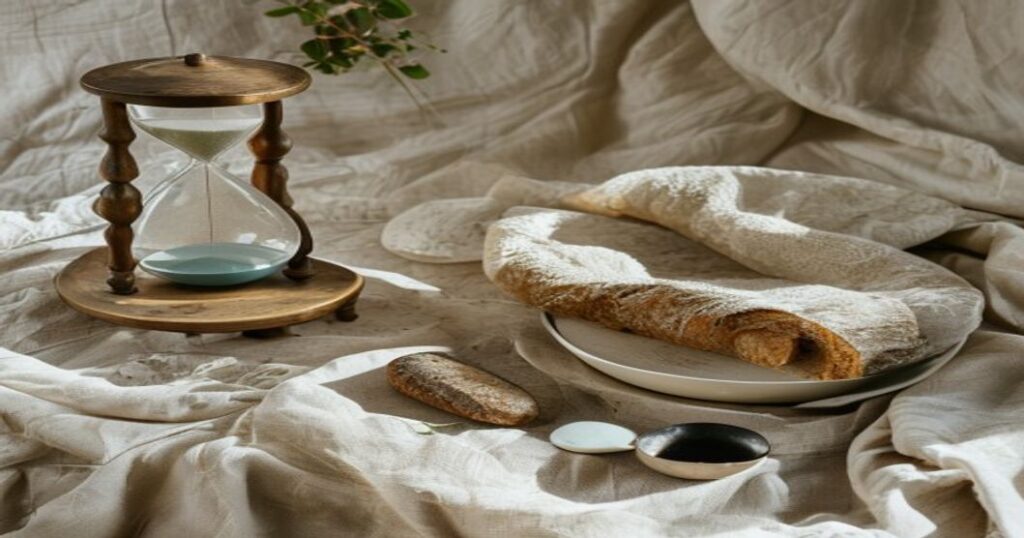
There’s a category of ordinary thing that works on us without asking permission.
You don’t notice these objects most days. They’re part of the background of your home — the bread on the counter, the candle on the shelf, the soft throw on the couch. But on a difficult afternoon, you reach for one of them without thinking, and something in your chest unclenches by a single click.
These are what I’d call everyday calming objects. They’re not wellness products. They’re not marketed. They haven’t been optimized by a startup. They’re just quietly present in human homes because, for reasons that are partly physics and partly psychology, they do something real to the nervous system.
I’ve been interested in this category for a long time because I make one of them for a living. But the list is much broader than any single product. Here are fifteen of them, and the specific reasons each one works.
1. A Loaf of Bread, Sitting On the Counter
It’s not just the smell. A loaf of bread — a real one, crusty, unwrapped, on a wooden board — is one of the most primally calming objects a human household can contain.
Part of this is ancestral. For most of human history, visible bread meant safety — a household that had eaten and would eat again. The image of it triggers an ancient enough-ness response that’s very hard to replicate with other objects.
Part of it is sensory. Bread looks texturally complex (all those irregular crust bubbles), smells pleasant without trying, and is soft to press — a tactile grounding object. And part of it is social: bread is the prototypical food to share, which carries warm associations even when you’re alone.
If you don’t have a bread culture in your home, even a beautiful store-bought sourdough left on a wooden board in the kitchen will do a lot of invisible emotional work all week.
2. A Wool Blanket, Weightier Than You Think
There’s a reason weighted blankets became a whole product category. But a heavy wool or merino throw — not a weighted-blanket product, just a heavy blanket — has always done a lighter version of the same thing.
The weight activates the proprioceptive system, the sense that tells you where your body is in space. Proprioceptive input is naturally calming to the nervous system — it’s why babies settle in swaddles, why hugs work, why a heavy coat makes a cold day feel cozier rather than confining. A real wool throw draped across your legs on a couch does this passively, every time you sit.
Pick real wool over synthetic. The thermal regulation matters (wool stays warm even when damp, synthetic gets clammy). Weight matters too — aim for 2+ kg (roughly 4+ lbs) for a throw-size blanket.
3. An Hourglass
Don’t confuse the hourglass with a clock.
A clock pressures you. The ticking, the digital readout, the progress bar — they’re all stimulus to act, to move, to beat the time. An hourglass does the opposite. It marks time by falling, which is visual, not imperative. You don’t feel pressured to keep up with it. You can just watch the sand fall.
There’s a whole sub-category of “contemplative time objects” — hourglasses, water clocks, pendulum clocks — that evolved before digital timekeeping and carry an aesthetic relationship to time that our phones can’t replicate. A glass hourglass in a wood stand on a mantel becomes a small everyday invitation to pause. Not do more. Pause.
4. A Smooth River Stone, Heavier Than Expected
The fidget object as ancient tool.
A smooth stone, cold to the touch, heavy for its size, is one of the oldest calming objects humans use. Buddhist traditions use mala beads and worry stones. Greek culture has the komboloi (worry beads). Mediterranean traditions have smooth sea stones kept in pockets. All of them are doing the same thing: giving your hands a focus that’s small, cold, heavy, and demands no decisions from your brain.
A single large river stone on a bookshelf or coffee table — the kind that fits in your palm, cool to the touch — is a passive invitation. Your hand will find it. Your nervous system will appreciate the cold weight.
5. Running Water — A Small Tabletop Fountain
Most people underrate the indoor fountain because most indoor fountains are ugly.
A good small fountain — ceramic, stone, or a minimal modern basin — is one of the most potent calming objects a room can contain. The sound of running water is one of the few natural sounds that human attention systems respond to as safety. (Predators hunt in quiet forests. Running water means the environment is active and non-threatening.)
The visual and auditory input combines into something close to the restorative effect of standing near a real stream. There’s significant evidence that moving-water sound reduces cortisol and blood pressure measurably.
The caveat: a cheap plastic fountain will undo the effect. Look for ceramic or stone; look for simple, sculptural shapes; and commit to cleaning it monthly.
6. A Simple Beeswax Candle, Unlit
Even unlit, a real beeswax candle is doing something.
The yellow-honey color is warm. The texture is soft. The scent — that faint honey aroma from the wax itself — is present even without the flame. A hand-rolled or dipped beeswax taper on a mantel is a calming object by its mere existence.
Lit, the effect deepens — firelight is one of the oldest calming stimuli, and beeswax burns cleaner and slower than paraffin. But the base effect is real even before the match.
7. A Bowl of Water
I know how this sounds.
But a shallow, wide ceramic bowl — the kind used in old Chinese scholar studios — filled with water and set on a surface, is one of the most underrated calming objects I know. It reflects the ceiling. Catches the light. Holds stillness. And if a leaf floats on it, or a small stone sits at the bottom, the composition becomes something closer to a living still life.
The Japanese tea ceremony has a related concept — the mizusashi, or water vessel — that recognizes water as a calming element in its own right, not just as a functional ingredient.
8. An Old Book With a Beautiful Cover
Not a new one. An old one. A hardcover with cloth binding, slightly worn.
Old books carry a certain quiet because they telegraph time. The object has existed longer than you have. It has been touched by other hands. It is evidence of persistence. Having a single beautifully-worn book on a coffee table — not stacked, not part of a shelf, just alone — provides a strong anchor of continuity.
There’s research on attachment to books as objects — for reasons partly aesthetic and partly symbolic, we read the presence of old books as home. A single well-chosen one does more emotional work than a shelf of new paperbacks.
9. A Moving Sand Picture
I’ll include my own because genuinely, the effect is about as strong as any object on this list.
A moving sand picture — colored sand falling slowly through liquid in a thin glass frame — works on attention in a specific way. It combines three of the calming effects described elsewhere in this post: the slow falling of an hourglass, the gentle unpredictability of moving water, and the visual depth of a small still life. All at once, all the time.
What makes it particularly useful as an everyday calming object is that, unlike fire or water, it doesn’t require maintenance. No flame to watch. No water to refill. No plant to keep alive. It just sits on a shelf and, every time you flip it, starts its slow geological performance over. You don’t have to be a wellness person to benefit from one. You just have to have it in a place where your eyes can find it when you need to look away from a screen.
10. A Shallow Ceramic Dish With Keys and a Watch
Tiny object, big effect.
A small dish by the door, or on a dresser, where keys and watches and small daily objects land — is a calming object in an invisible way. It turns the act of arrival home into a ritual. The keys clink into the dish. The watch comes off. The phone (ideally) gets put face down next to it. The dish is the visible container for a micro-transition from “out” to “in.”
Most people skip this. Their keys end up on the counter, on the couch, in a bag. The ritual dissolves. A dedicated, beautiful small dish — handmade ceramic, brass, or wood — creates the slot for the ritual to live in.
11. A Loom, a Bread Board, a Mortar and Pestle
This is one object, conceptually: tools with visible woodgrain that have been used.
A mortar and pestle on the counter, darkened slightly by spice oil. A wooden bread board with knife marks. A hand loom with a project half-finished. These are calming because they carry the visible record of being used. They’re not decor — they’re evidence of practice.
In a culture that hides its tools, a household that keeps a few working tools visible reads as grounded in a way that’s very hard to fake with styling.
12. A Pair of Well-Used Boots
At the door. Not new. Shaped by the person who wears them.
Boots carry the shape of your feet. They register your habits. Having your boots visible at the entry — instead of hidden in a closet — communicates (to you, subconsciously, every time you come home) that you have a life outside the house. You’re someone who walks places. You return. The boots wait.
This is especially calming for people working from home, where the line between inside-life and outside-life blurs. Visible boots are a small flag for the outside self.
13. An Unironed Linen Something
Linen is the natural world’s counter to the era of perfectly-pressed clothes.
A linen shirt draped on a chair. A linen tea towel on a hook. A linen cushion cover with the wrinkles left in. The relaxed, un-ironed quality of real linen is a visual signal of domestic ease. It reads as someone lives here, not someone is performing a catalog photo here.
The psychological effect is real: we relax, a little, in spaces that don’t feel rehearsed. Deliberate imperfection is calming. A single un-ironed linen piece does a lot of this work.
14. A Small Plant You Actually Touch
Not a large statement plant. A small herb or soft-leaved plant — basil, rosemary, lavender, or a pilea — on the kitchen windowsill.
The distinction matters: large decor plants are visual. Small interactive plants are sensory. You brush the rosemary as you pass. You pick a leaf of basil. You check the soil of the pilea. You make micro-contact with a living thing multiple times a day, without ceremony. That repeated contact is calming in a way that the fiddle-leaf-fig-in-the-corner isn’t.
15. A Bowl of Lemons
The oldest trick in the still-life painter’s book, and it still works.
A low wide ceramic bowl holding four or five lemons, on a kitchen table or counter. That’s it. The bright yellow against any backdrop is one of the most visually uplifting domestic arrangements you can make. The curve of the fruit, the faint citrus smell when you lean close, the sense of abundance — it’s been a calming subject for painters for 400 years because it does exactly what it looks like it does.
Apples, pears, pomegranates all work too, but lemons have the specific uplift of yellow, which the human eye registers as warmth and hospitality before you’ve consciously noticed it.
What These Objects Have in Common
Look at all fifteen. The pattern is consistent.
None of them are products you’d find in a wellness store. None of them beep, vibrate, push notifications, or update. Most of them involve natural materials — wax, wool, wood, stone, water, fruit, fiber. Most of them are either still or slowly-moving — nothing on this list is fast or loud. And almost all of them are single objects, not sets — singular presence beats coordinated collection for calming effect.
The broader lesson: the calming object category lives largely outside of what gets marketed as calming. The tea lights and bath bombs and rose-quartz-infused-water-bottles that fill the wellness aisle mostly aren’t doing the work that an actual bread loaf on an actual wooden board does for free.
The fix is quiet. Populate your home with a few real, simple, evocative things. Keep them where your eyes can find them. Touch them with your hands when you need to. Let them do their ancient work.
Written by Vee Sharma, founder of Moving Sandscape. If you found this useful, you might enjoy looking at our deep-sea sandscape — the kinetic sand piece that prompts most of the writing on this blog.